Mountain vs Lowland Gorilla Differences: Complete Guide for Safari Visitors
Understanding the mountain vs. lowland gorilla differences can help safari visitors appreciate the remarkable diversity of gorillas. Although all gorillas belong to the same genus, Gorilla, different gorilla populations have adapted to different habitats across Central and East Africa.
Mountain gorillas are especially well known because travelers can observe them during guided trekking experiences in Uganda, Rwanda, and the Democratic Republic of Congo. Lowland gorillas live primarily in the tropical forests of Central Africa and include western lowland gorillas and eastern lowland gorillas, also known as Grauer’s gorillas.
The differences between these gorillas include habitat, body characteristics, fur, diet, behavior, population distribution, and conservation challenges. Some differences are obvious, while others become clearer when researchers study their ecology and genetics.
For safari visitors, learning these distinctions provides useful context before visiting a gorilla habitat. It also explains why mountain gorilla trekking is different from other wildlife experiences involving lowland gorillas.
What Are Mountain Gorillas?
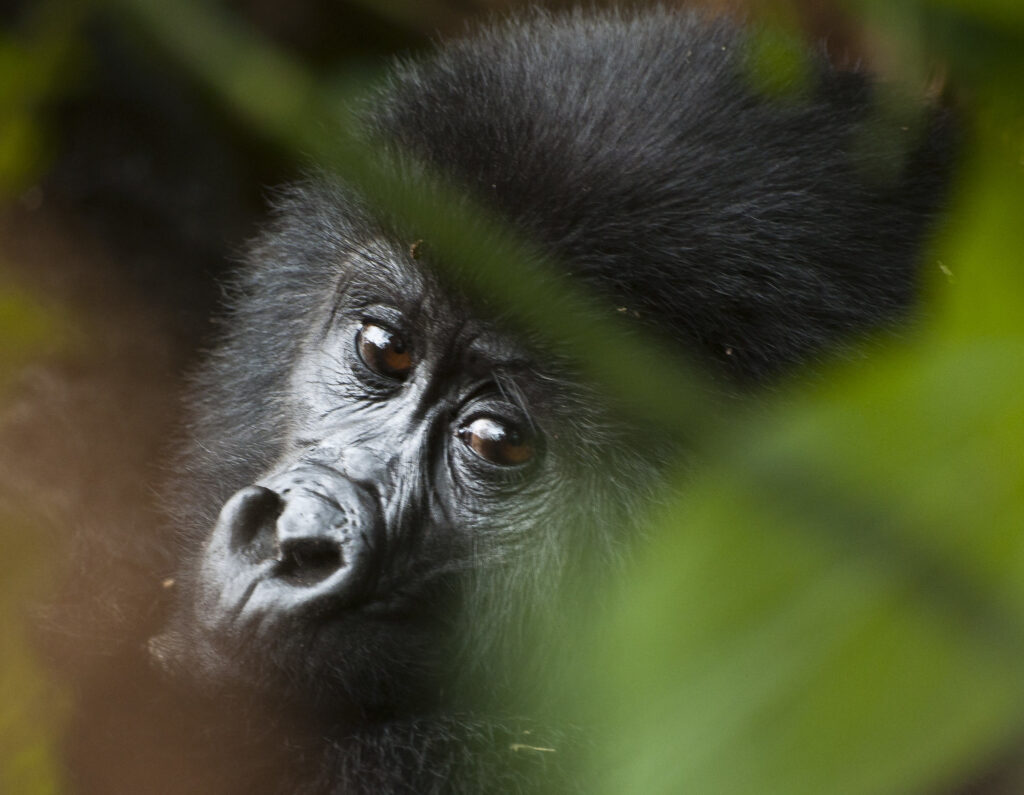
Mountain gorillas are one of the recognized populations of eastern gorillas.
They live at high elevations in the mountainous forests of Uganda, Rwanda, and the Democratic Republic of Congo.
The main populations occur in the Virunga Massif and Uganda’s Bwindi region.
Mountain gorillas have adapted to cooler, wetter, high-altitude environments.
Their thick fur helps them cope with colder conditions.
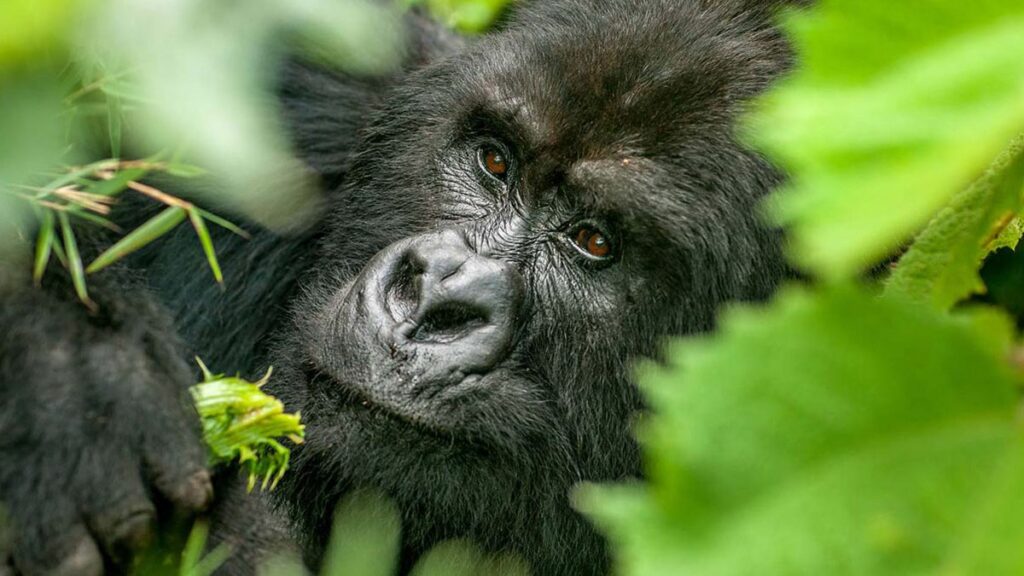
They spend much of their time on the ground and feed heavily on leaves, stems, shoots, and other vegetation.
What Are Lowland Gorillas?
The term “lowland gorilla” generally refers to gorillas living at lower elevations.
The two best-known forms are western lowland gorillas and eastern lowland gorillas.
Western lowland gorillas occur across parts of Central and West-Central Africa.
Eastern lowland gorillas, commonly called Grauer’s gorillas, occur mainly in the eastern Democratic Republic of Congo.
Their habitats include tropical forests at lower elevations than those occupied by mountain gorillas.
Mountain vs Lowland Gorilla Differences in Habitat
One of the clearest mountain vs. lowland gorilla differences is habitat.
Mountain gorillas live in high-altitude forests, often in mountainous terrain.
Their habitat includes bamboo zones, montane forests, dense vegetation, and steep slopes.
Lowland gorillas generally occupy tropical lowland and transitional forests.
These forests can contain different plant communities, fruiting trees, and vegetation structures.
The different habitats have influenced the physical and behavioral adaptations of each gorilla population.
Difference in Elevation
Mountain gorillas are associated with significantly higher elevations.
Their habitat can extend to elevations of more than 4,000 meters in parts of their range.
Lowland gorillas generally live at much lower elevations.
This difference affects temperature, vegetation, terrain, and food availability.
It also explains why mountain gorilla trekking can involve steep and physically demanding hiking.
Mountain vs Lowland Gorilla Differences in Fur
Mountain gorillas generally have thicker and longer fur than lowland gorillas.
Their dense coat helps protect them from the cooler temperatures found at high elevations.
Lowland gorillas generally have shorter and less dense hair.
The difference is particularly noticeable when the two types are compared visually.
However, individual variation exists, so fur thickness alone should not be used to identify a gorilla.
Differences in Body Build
Mountain gorillas tend to have a robust body structure with broad chests and powerful limbs.
Their physical build helps them navigate mountainous terrain and dense vegetation.
Lowland gorillas also have powerful bodies but can appear somewhat more slender in comparison.
The exact body shape varies according to sex, age, population, and individual condition.
Adult males in both groups can become extremely strong and muscular.
Mountain vs Lowland Gorilla Differences in Size
Both mountain and lowland gorillas are large primates.
Adult males can weigh well over 100 kilograms, although individual weights vary.
Mountain gorillas often have a particularly stocky appearance.
Lowland gorillas can also reach impressive sizes.
Body weight is influenced by age, sex, nutrition, health, and individual variation, so size alone cannot reliably distinguish the populations.
Differences in Face and Nose
Mountain gorillas and lowland gorillas can show subtle differences in facial appearance.
Mountain gorillas often have broad faces and prominent brow ridges.
Lowland gorillas may have somewhat different facial proportions.
However, identification requires experience because individual gorillas can vary considerably.
Researchers consider several characteristics rather than relying on one physical feature.
Differences in Diet
Diet is another important mountain vs. lowland gorilla difference.
Mountain gorillas consume large amounts of leaves, stems, shoots, bark, flowers, and other vegetation.
Their high-altitude habitat provides abundant herbaceous vegetation.
Lowland gorillas generally have greater access to fruit.
Western lowland gorillas are particularly known for consuming substantial amounts of fruit when it is seasonally available.
This difference can influence movement patterns.
Fruit Availability and Movement
Mountain gorillas often have relatively stable access to terrestrial vegetation.
They can therefore spend considerable time feeding within a relatively concentrated area.
Lowland gorillas may travel greater distances when searching for seasonal fruits.
Fruit availability can influence where lowland groups move and how widely they use their habitat.
This creates differences in ranging behavior between populations.
Mountain vs Lowland Gorilla Differences in Social Groups
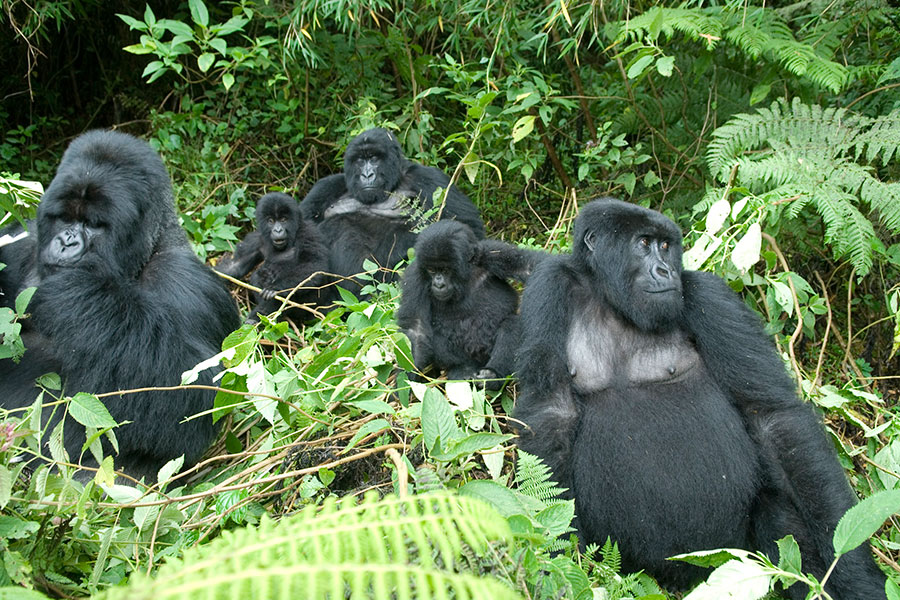
Mountain gorillas commonly live in relatively stable social groups.
Groups can contain a dominant silverback, other males, females, juveniles, and infants.
Lowland gorillas also form social groups, but their group structures can differ depending on species and environmental conditions.
Western lowland gorillas, for example, can display flexible social organization.
Social structure can therefore vary considerably across gorilla populations.
Differences in Group Size
Mountain gorilla groups can contain several individuals and sometimes become relatively large.
Lowland gorilla groups can also vary considerably in size.
Some lowland populations may form smaller groups, while others can gather into larger social units.
Food availability, habitat structure, reproduction, and social relationships can influence group size.
There is no single group size that applies to every gorilla population.
Mountain vs Lowland Gorilla Differences in Behavior
Both mountain and lowland gorillas demonstrate complex social behavior.
They groom one another, communicate, care for the young, play, feed together, and maintain social relationships.
However, differences in habitat and food resources influence how these behaviors are expressed.
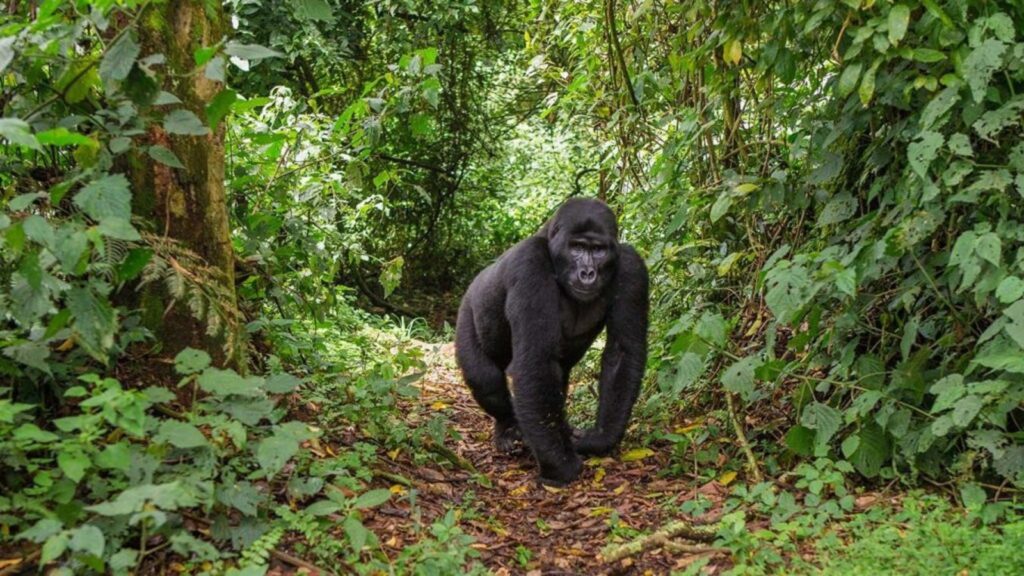
Mountain gorillas spend much of their time on the ground.
Some lowland gorillas may spend more time climbing or using forest vegetation.
Differences in Tree Use
Mountain gorillas are predominantly terrestrial.
Their mountainous habitat and body structure favor movement on the ground.
Lowland gorillas can make greater use of trees and forest vegetation, particularly when feeding on fruit.
However, lowland gorillas are not strictly arboreal.
Both types spend substantial time on the forest floor.
Mountain vs Lowland Gorilla Differences in Nesting
Both mountain and lowland gorillas construct nests for resting and sleeping.
Mountain gorillas commonly construct ground nests.
Lowland gorillas may also build ground nests but can make greater use of vegetation above the ground in some circumstances.
Nest location can depend on habitat, age, individual preference, and available vegetation.
Differences in Conservation Status
Conservation challenges differ between mountain and lowland gorillas.
Mountain gorillas have a very restricted geographic range and remain endangered.
Their populations have benefited from intensive conservation programs, veterinary monitoring, habitat protection, and carefully managed tourism.
Western lowland gorillas face serious threats from habitat loss, hunting, disease, and illegal wildlife trade.
Grauer’s gorillas face significant threats from habitat destruction, hunting, and insecurity in parts of their range.
Mountain Gorilla Conservation
Mountain gorilla conservation involves several interconnected efforts.
Protected areas safeguard their forest habitat.
Researchers monitor individual gorillas and groups.
Veterinary teams can provide specialized care when necessary.
Tourism generates revenue that supports conservation and local communities.
These combined approaches have contributed to important population gains over recent decades.
Lowland Gorilla Conservation
Lowland gorillas require extensive forest landscapes.
Protecting these areas can be challenging because their habitats cover much larger regions.
Threats include deforestation, hunting, mining, disease, and human encroachment.
Conservation organizations and governments work to protect remaining populations and improve management of forest habitats.
Mountain vs Lowland Gorilla Differences in Tourism
Mountain gorillas are particularly famous for guided trekking tourism.
Visitors can track habituated groups in Uganda, Rwanda, and the Democratic Republic of Congo.
Lowland gorilla tourism is less widespread.
Some tourism opportunities exist in Central African forests, but they generally do not have the same international profile or infrastructure as mountain gorilla trekking.
This difference makes mountain gorillas one of Africa’s most sought-after wildlife experiences.
Which Gorillas Do Tourists Trek in Uganda?
Visitors to Uganda can trek mountain gorillas in Bwindi Impenetrable National Park and Mgahinga Gorilla National Park.
These protected areas form part of the habitat of the critically important mountain gorilla population.
Tourists do not travel to Uganda specifically to trek western lowland or Grauer’s gorillas.
Uganda’s famous gorilla trekking experience focuses on mountain gorillas.
Which Gorillas Are Found in Rwanda?
Rwanda’s gorilla trekking experience takes place in Volcanoes National Park.
The park protects part of the Virunga mountain ecosystem.
The gorillas encountered by visitors are mountain gorillas.
This makes Rwanda another major destination for mountain gorilla tourism.
Which Gorillas Are Found in the Democratic Republic of Congo?
The Democratic Republic of Congo contains several gorilla populations.
Mountain gorillas occur in the Virunga region.
Grauer’s gorillas, also known as eastern lowland gorillas, occur in other parts of eastern Congo.
The two populations have different habitats and conservation circumstances.
Mountain vs Lowland Gorilla Differences for Safari Visitors
For visitors, the most noticeable differences involve where the animals live and how they are encountered.
Mountain gorilla trekking usually involves hiking through steep, humid mountain forests.
The experience can involve challenging terrain and changing weather.
Lowland gorilla experiences, where available, generally take place in tropical forest environments at lower elevations.
The landscapes and trekking conditions can therefore be very different.
Are Mountain Gorillas More Aggressive?
Mountain gorillas are not naturally aggressive toward humans.
Like other wild animals, they can become defensive if they feel threatened.
Their behavior depends on the situation.
Silverbacks may display strength through chest beating, vocalizations, body posture, or movement when responding to perceived threats.
Visitors should always follow guide instructions and maintain the required distance.
Are Mountain Gorillas and Lowland Gorillas the Same Species?
The classification of gorilla populations is complex.
Gorillas are generally divided into two species, the eastern gorilla and western gorilla, with recognized subspecies and populations within them.
Mountain gorillas are classified as Gorilla beringei beringei.
Grauer’s gorillas are classified as Gorilla beringei graueri.
Western lowland gorillas are classified as Gorilla gorilla gorilla.
These classifications reflect evolutionary relationships and geographic differences.
Can Mountain Gorillas and Lowland Gorillas Interbreed?
Mountain gorillas and lowland gorillas belong to closely related populations within the gorilla genus.
However, they live in geographically separated habitats, which limits natural contact.
The differences between populations have developed over long periods of evolutionary history.
Conservation efforts focus on protecting each population within its natural range.
Mountain vs Lowland Gorilla Differences at a Glance
Feature Mountain Gorillas Lowland Gorillas
Main habitat: High-altitude mountain forests Tropical lowland forests
Main regions: Uganda, Rwanda, DRC, central and eastern Africa
Fur Generally thicker and longer Generally shorter
Diet: Mostly leaves, stems and shoots More fruit available in many areas
Tree use Mostly terrestrial Greater use of forest vegetation
Tourism: Highly developed trekking tourism More limited tourism
Major threats: disease, habitat pressure and human disturbance Hunting, habitat loss, disease and other pressures
Famous destinations: Bwindi, Mgahinga and Volcanoes Selected Central African forest areas
Why These Differences Matter
Understanding the mountain vs. lowland gorilla differences helps visitors appreciate why different gorilla populations require different conservation strategies.
Mountain gorillas occupy a small and highly specialized habitat.
Lowland gorillas depend on much larger tropical forest landscapes.
Protecting both requires habitat conservation, community involvement, scientific research, law enforcement, and responsible tourism.
Each population contributes to the biological diversity of Africa’s great apes.
Conclusion
The mountain vs. lowland gorilla differences involve much more than where the animals live. Mountain gorillas have adapted to high-altitude forests and generally have thicker fur, a robust body structure, and a largely terrestrial lifestyle. Their diet consists heavily of leaves, stems, shoots, and other vegetation.
Lowland gorillas live in warmer tropical forests and generally have greater access to fruit. Their ranging patterns, tree use, social organization, and habitat requirements can therefore differ from those of mountain gorillas.
For safari visitors, mountain gorillas are particularly accessible through carefully managed trekking experiences in Uganda, Rwanda, and the Democratic Republic of Congo. Lowland gorillas remain less commonly encountered by tourists and face different conservation challenges.
Regardless of these differences, all gorillas share complex social lives, strong family relationships, impressive intelligence, and important ecological roles. Protecting their habitats and supporting responsible conservation remains essential for ensuring that future generations can continue to experience these remarkable great apes.