
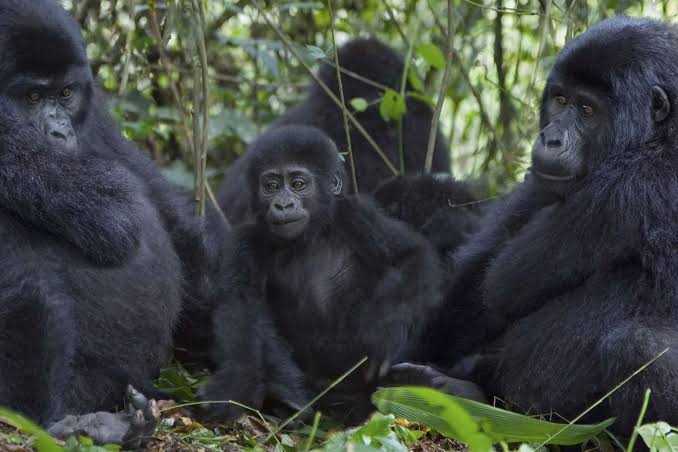
Gorilla Family Group Size in Uganda, Rwanda and Congo
The gorilla family group size is an important part of understanding mountain gorilla behavior and planning a gorilla trekking safari in Africa. Mountain gorillas live in social groups rather than alone, with several individuals forming a family that normally includes a dominant silverback, adult females, younger males, juveniles, and infants.
The number of gorillas in a family can vary considerably. Some groups may contain only a few individuals, while others can have more than 20 members. Family size also changes naturally as gorillas are born, die, transfer between groups, or establish new social units.
Uganda, Rwanda, and the Democratic Republic of Congo are home to the world’s remaining mountain gorillas. Although the gorillas in these destinations share similar social structures, individual family sizes differ from one group to another.
Understanding gorilla family group size helps travelers appreciate why gorilla families are dynamic social communities and why the group you visit today may have a different composition in the future.
How Large Is a Gorilla Family?
There is no fixed number of gorillas in every family.
Mountain gorilla groups commonly contain several individuals, but their size can range from very small groups to families containing more than 20 gorillas.
The number depends on the group’s history and social structure.
A typical family may include one dominant silverback, other adult males, several adult females, juveniles, and infants. Some groups may contain multiple silverbacks, particularly when younger males remain with the family or when leadership structures change.
Family size can therefore change naturally over time.
What Determines Gorilla Family Group Size?
Several factors influence the size of a gorilla family.
Births increase the number of individuals, while deaths reduce it. Young males may eventually leave their natal group and become solitary or establish their own groups.
Adult females can also transfer between groups.
A dominant silverback may attract females and build a larger social unit, while competition or leadership changes can cause a family to split.
These natural processes mean that gorilla family size is constantly changing.
A mountain gorilla family is usually centered around one or more adult males and a group of females and young gorillas.
The dominant silverback plays an important leadership and protective role.
Adult females form important social relationships within the group.
Young gorillas remain close to their mothers during their early years and gradually become more independent.
Juveniles spend considerable time playing and learning social behaviors.
This structure allows the family to function as a close social community.
The Role of the Silverback
The silverback is usually the dominant adult male in a gorilla family.
He helps protect the group from potential threats and may determine when the family moves, rests, or changes location.
The silverback also plays an important role in maintaining social stability.
A family may contain more than one silverback, but one male normally holds the dominant position.
Younger males may remain in the group for some time before eventually leaving.
How Many Silverbacks Can Be in One Family?
A gorilla family does not necessarily contain only one adult male.
Some groups include several silverbacks or younger blackback males.
A subordinate silverback may remain within the group while the dominant male maintains leadership.
This arrangement can provide additional protection and create complex social relationships.
If leadership changes, the structure of the family can also change.
Adult Females in Gorilla Families
Adult females form an important part of mountain gorilla social groups.
They often maintain close relationships with other members of the family.
Females can also move between groups, which contributes to genetic diversity and changes in family composition.
A group with several reproductive females may grow steadily through the birth of new infants.
Baby Gorillas and Family Size
Baby gorillas naturally increase family size as they are born into the group.
Infants remain closely attached to their mothers during their early development.
Visitors may sometimes see mothers carrying infants or young gorillas resting nearby.
As babies grow, they become increasingly active and begin interacting with other juveniles.
These young gorillas eventually become independent members of the family.
Juveniles and Gorilla Social Groups
Juvenile gorillas are important members of the family.
They spend considerable time playing, climbing, exploring vegetation, and interacting with other young gorillas.
Play helps them develop physical coordination and learn social behavior.
Juveniles also observe adults and gradually learn how to respond to different social situations.
Their development contributes to the changing structure of the family.
Gorilla Family Group Size in Uganda
Uganda is one of the most important destinations for mountain gorilla trekking.
The country’s mountain gorillas live primarily in Bwindi Impenetrable National Park and Mgahinga Gorilla National Park.
Gorilla families in Bwindi vary in size.
Some groups contain relatively small numbers of individuals, while others can contain more than 10 or 20 gorillas.
The exact composition changes regularly because gorillas are naturally social and mobile animals.
Gorilla Families in Bwindi
Bwindi is divided into several trekking sectors, including Buhoma, Ruhija, Rushaga, and Nkuringo.
Different habituated gorilla families are associated with these areas.
Families such as Mubare, Habinyanja, Rushegura, Oruzogo, Nkuringo, and others have different histories and group compositions.
The number of gorillas in a particular family can change after births, deaths, transfers, group splits, or changes in leadership.
Travelers should therefore avoid relying on old group-size information when planning a trek.
Gorilla Family Group Size in Mgahinga
Mgahinga Gorilla National Park protects part of the Virunga mountain gorilla population.
The park has historically been associated with the Nyakagezi gorilla family, which became habituated for tourism.
The family has experienced changes in membership and leadership over time.
This demonstrates why gorilla family size should be understood as a changing biological characteristic rather than a permanent number.
Gorilla Family Group Size in Rwanda
Rwanda’s mountain gorillas live in Volcanoes National Park.
The park forms part of the wider Virunga ecosystem.
Several habituated gorilla families are available for controlled tourism.
Family sizes differ from one group to another, and the composition can change naturally.
Some families may contain only a handful of individuals, while others can have considerably larger memberships.
Gorilla Families in Volcanoes National Park
Visitors to Rwanda may encounter families with well-known names such as Susa, Amahoro, Agashya, Sabinyo, Kwitonda, and others.
Each family has its own history and social structure.
A group that contains many individuals can provide opportunities to observe different age classes and social interactions.
A smaller family can offer a more intimate view of gorilla relationships.
Neither group size guarantees a better trekking experience.
Gorilla Family Group Size in Congo
The Democratic Republic of Congo is home to mountain gorillas in the Virunga region.
Gorilla families in this area also vary in size and composition.
The social structure is broadly similar to that of mountain gorillas in Uganda and Rwanda.
However, tourism operations in the region can change according to security and park conditions.
Travelers should obtain current information before planning a gorilla trek in Congo.
How Many Gorillas Are in a Typical Family?
A typical mountain gorilla family can contain several individuals, but there is no universal standard size.
Groups may contain fewer than 10 members or grow to more than 20.
Some exceptional groups can become considerably larger.
The important point is that family size is flexible.
A gorilla family is a social unit rather than a fixed-size group.
Can Gorilla Families Become Larger?
Yes.
A family can grow through births and the arrival of new individuals.
If several adult females reproduce successfully, the number of infants and juveniles can gradually increase.
Young males may also remain within the family for a period.
A strong silverback may maintain a stable group for many years, allowing the family to become relatively large.
Can Gorilla Families Become Smaller?
Yes.
Deaths, transfers, and group splits can reduce the number of individuals.
Young males may leave their natal group.
Females may transfer to another family.
A family can also divide because of changes in leadership or social relationships.
These natural processes are important parts of gorilla population dynamics.
Why Do Gorilla Families Split?
Gorilla groups can split for several reasons.
Social relationships can change as young males mature.
Competition between males may increase.
A new silverback may establish an independent group.
Females may also move between groups.
When a group divides, each resulting social unit can develop its own identity and eventually become recognized as a separate family.
Can Gorillas Join Another Family?
Yes.
Gorillas are not permanently tied to one family throughout their lives.
Adult females commonly transfer between groups.
Young males may leave their natal families and spend time alone before forming or joining another group.
These movements help maintain genetic exchange between gorilla populations.
Gorilla Family Size and Trekking Group Size Are Different
Travelers should not confuse gorilla family group size with the number of tourists allowed to visit a family.
A gorilla family may contain many individuals.
The number of visitors allowed to observe the group is much smaller and is controlled by wildlife authorities.
Visitor limits exist to reduce disturbance and protect the animals.
Therefore, seeing a family with 15 gorillas does not mean that 15 tourists can visit it.
Why Visitor Numbers Are Limited
Mountain gorillas are endangered wild animals, and excessive human contact can create health and behavioral risks.
Limiting visitor numbers reduces pressure on habituated families.
It also helps maintain a high-quality wildlife experience.
Trekking regulations can change, so visitors should always confirm the current rules before traveling.
Does a Larger Gorilla Family Mean a Better Trek?
Not necessarily.
A large family may provide opportunities to observe many individuals at different ages.
Visitors could see infants, juveniles, adult females, blackbacks, and silverbacks interacting.
However, a smaller family can provide equally interesting observations.
The quality of a trek depends on the animals’ behavior, visibility, forest conditions, and the expertise of the trackers.
What Can You See in a Large Gorilla Family?
Large groups can offer a wide variety of social behaviors.
Visitors may see juveniles playing, mothers caring for infants, adults grooming one another, and silverbacks monitoring the group.
Different individuals may be engaged in different activities simultaneously.
This can make a large family particularly interesting for photographers and wildlife enthusiasts.
What Can You See in a Small Gorilla Family?
Smaller families can provide a different experience.
With fewer individuals, it may be easier to observe relationships between specific gorillas.
Visitors might see a mother and infant interacting closely or observe a silverback maintaining contact with a small group.
A smaller family can also demonstrate how flexible gorilla social structures can be.
Gorilla Family Size and Conservation Research
Monitoring family size is important for gorilla conservation.
Researchers record births, deaths, migrations, transfers, and changes in group composition.
These records help scientists understand population growth and social dynamics.
Long-term monitoring can also identify potential threats to individual animals or entire populations.
Gorilla Family Size and Population Growth
Births and survival of young gorillas contribute to population growth.
However, population numbers cannot be understood simply by counting births.
Researchers must also consider mortality, migration, group formation, and other demographic factors.
Long-term population monitoring therefore provides a more accurate picture of gorilla conservation progress.
Gorilla Family Size and Genetic Diversity
Movement between gorilla groups has genetic importance.
When females transfer between families, they can introduce genetic variation into new groups.
Young males that establish new groups can also contribute to the genetic structure of future generations.
Maintaining healthy populations and connected habitats is therefore important for long-term genetic diversity.
How Guides Know the Family Size
Gorilla trackers and researchers maintain detailed records of habituated families.
They learn to recognize individual gorillas through facial features, nose patterns, scars, body characteristics, behavior, and other identifying traits.
This allows them to estimate and monitor the composition of each group.
However, the recorded number can change after births, deaths, movements, or other natural events.
Can You See Every Gorilla in a Family?
Not necessarily.
A family can spread through dense vegetation while feeding or moving.
Some individuals may remain hidden behind leaves or on steep terrain.
Infants may stay close to their mothers.
Other gorillas may move farther from the main group.
Visitors should therefore not expect every member of a family to be visible throughout the entire encounter.
Frequently Asked Questions About Gorilla Family Group Size
How many gorillas are usually in a family?
Mountain gorilla families can contain several individuals and may range from small groups to families with more than 20 members. There is no fixed number.
What is the largest gorilla family?
Family sizes change over time, so there is no permanent largest family. Some groups can become exceptionally large before splitting or changing composition.
How many gorillas can tourists see during a trek?
This depends on the family and visibility on the day. Visitors may see only part of the group because some individuals can remain hidden in vegetation.
Is gorilla family size the same as trekking group size?
No. A gorilla family can contain many individuals, while the number of tourists permitted to observe the family is separately regulated.
Do gorilla families change size?
Yes. Births, deaths, transfers, departures, and group splits can all change the size of a gorilla family.
Are Uganda, Rwanda, and Congo gorilla families similar?
Mountain gorilla families across these countries have broadly similar social structures because they belong to the same mountain gorilla population. Individual family sizes and histories vary.
Conclusion
The gorilla family group size varies naturally across Uganda, Rwanda, and the Democratic Republic of Congo. Some mountain gorilla families contain only a few individuals, while others can grow to more than 20 members.
A typical family may include a dominant silverback, other adult males, adult females, juveniles, and infants. The number changes over time as gorillas are born, die, transfer between groups, mature, or establish new social units.
Uganda’s Bwindi Impenetrable National Park and Mgahinga Gorilla National Park, Rwanda’s Volcanoes National Park, and the Virunga region of the Democratic Republic of Congo all contain mountain gorilla families with their own unique histories and social structures.
For travelers, family size should not be the only factor when considering a gorilla trek. A large group can provide spectacular opportunities to observe social interactions, while a smaller family can offer an equally fascinating look at individual relationships.
Most importantly, gorilla family group size is constantly changing. The family you encounter during your safari is a living social community, not a fixed collection of animals. Understanding this dynamic makes a gorilla trekking experience even more meaningful and highlights the importance of long-term conservation and monitoring.



