Orangutan vs Gorilla Safari: Which Should You Do First?
Choosing between an orangutan safari and a gorilla safari can be difficult for travelers who want to experience Africa or Southeast Asia’s most remarkable great apes. Both experiences provide close encounters with intelligent, endangered primates in natural forest environments, but the experiences are very different. Understanding these differences can help travelers decide which safari should come first and whether combining both experiences is realistic.
The orangutan vs. gorilla safari comparison usually involves two very different destinations. Gorilla trekking commonly takes place in Uganda and Rwanda, with Uganda offering trekking in Bwindi Impenetrable National Park and Mgahinga Gorilla National Park. Uganda Wildlife Authority describes gorilla trekking as an activity that can last approximately two to seven hours, with visitors spending one hour observing a habituated gorilla family.
Orangutan experiences take travelers to Indonesia, particularly destinations such as Gunung Leuser National Park in Sumatra and Tanjung Puting National Park in Indonesian Borneo. Indonesia’s official tourism information highlights Gunung Leuser as an important habitat for Sumatran orangutans, while Tanjung Puting provides opportunities to explore rainforest by river and observe orangutans in their natural environment.
The decision therefore involves more than simply choosing between two animals. Travelers should consider the destination, trekking style, wildlife behavior, travel time, conservation experience, budget, physical requirements, and the type of encounter they want.
What Is the Difference Between an Orangutan Safari and a Gorilla Safari?
An orangutan safari and a gorilla safari both focus on great apes, but their environments and wildlife encounters differ considerably. Gorilla trekking normally involves walking through mountainous rainforest in search of a habituated gorilla family. In Uganda, the main destinations are Bwindi Impenetrable National Park and Mgahinga Gorilla National Park. Bwindi is divided into the Buhoma, Ruhija, Rushaga, and Nkuringo trekking sectors.
Orangutan safaris generally take place in tropical lowland or swamp forests in Indonesia. In Sumatra, Bukit Lawang provides access to Gunung Leuser National Park, where visitors can trek through rainforest in search of Sumatran orangutans.
In Borneo, Tanjung Puting offers a different style of wildlife experience. Travelers can travel along forest rivers in traditional klotok boats before exploring the rainforest and visiting locations associated with orangutan conservation.
This creates an important distinction. Gorilla trekking is generally a focused tracking experience centered on finding a particular habituated family. Orangutan safaris can combine trekking, river travel, forest exploration, and wildlife observation.
Gorilla Safari Experience
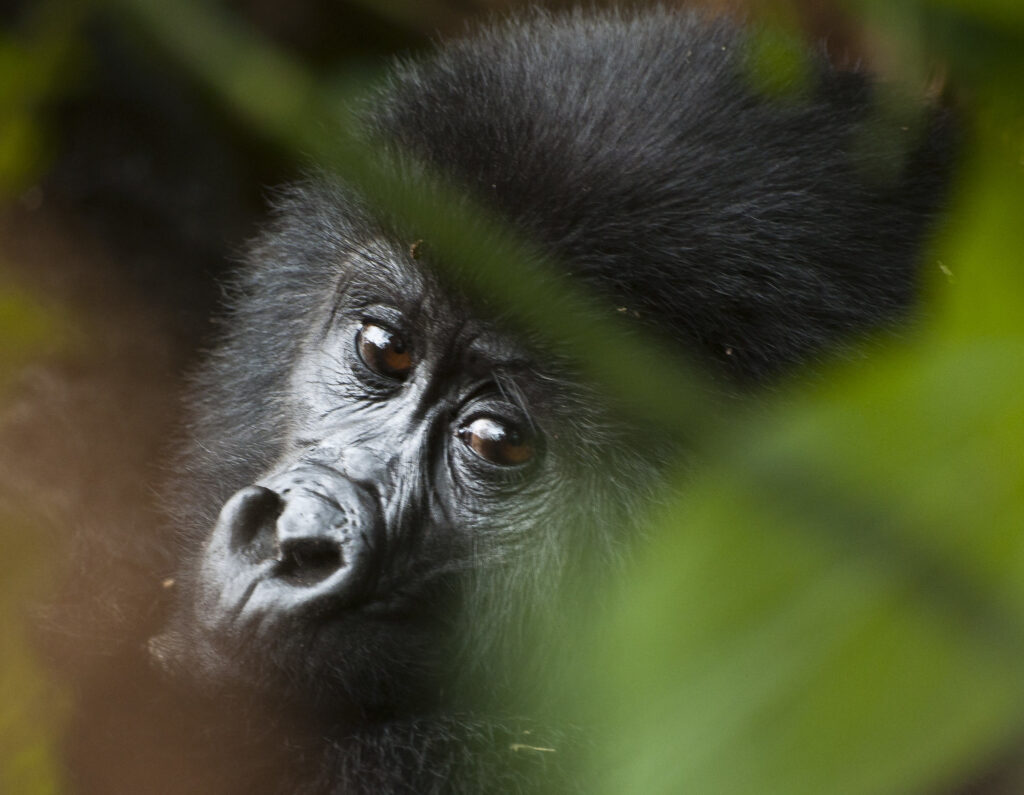
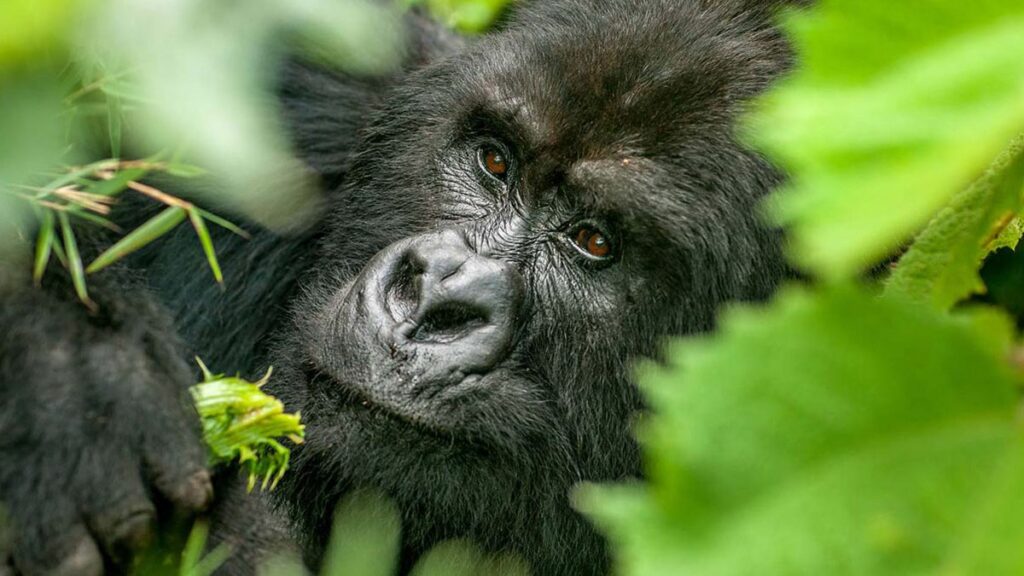
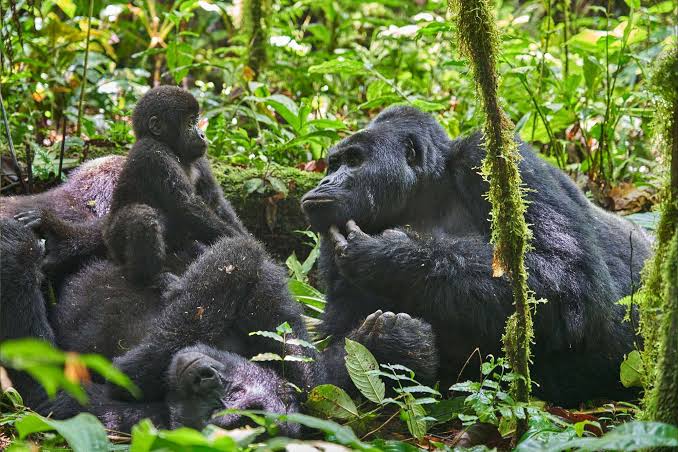
A gorilla safari provides an unusually intimate wildlife encounter. Visitors travel into forest habitat with trained guides and trackers to locate a habituated gorilla family. Once the group reaches the gorillas, visitors observe their behavior while following established tourism and conservation guidelines.
Uganda Wildlife Authority states that gorilla trekking requires moderate fitness and can last between two and seven hours depending on the circumstances of the trek. Visitors receive one hour of observation with a habituated gorilla family.
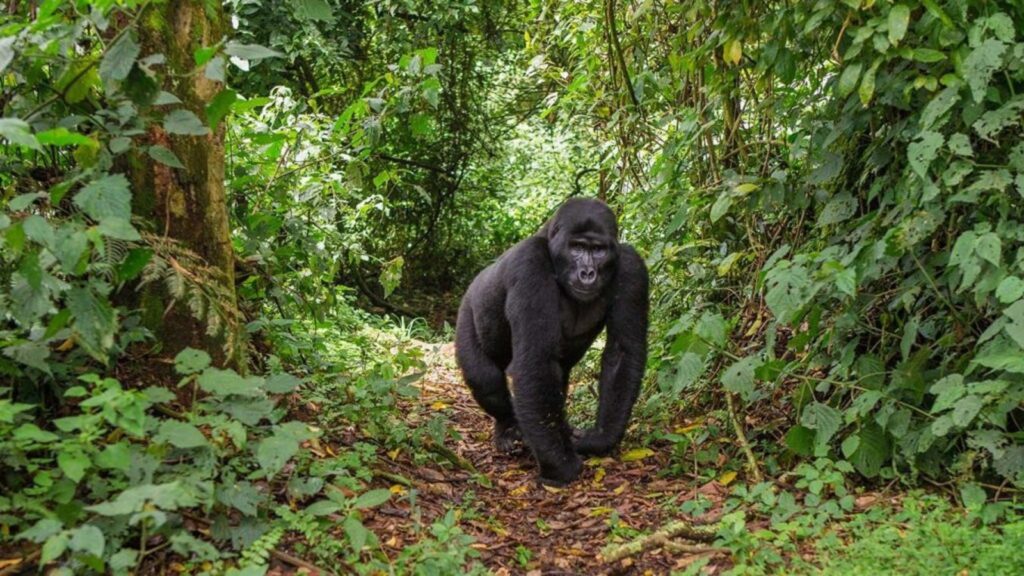
The mountainous environment is an important part of the experience. Bwindi’s forest contains steep slopes, dense vegetation, muddy trails, and changing conditions. The difficulty of a particular trek can vary because gorillas move through the forest and their location changes.
The encounter itself can be extremely engaging because visitors may observe silverbacks, adult females, juveniles, infants, feeding behavior, movement, vocalizations, resting, and interactions between members of the group.
For travelers who want a concentrated wildlife experience centered on one great-ape family, gorilla trekking provides a very different experience from a conventional game drive.
Orangutan Safari Experience
An orangutan safari offers a different type of wildlife adventure. Orangutans spend much of their time in trees, which means visitors may need to look upward into the forest canopy rather than searching primarily along the ground.
Sumatran orangutans are found in the forests of Sumatra, particularly around Gunung Leuser National Park. Indonesia’s official tourism information identifies the park as important habitat for orangutans and other rare wildlife.
Bukit Lawang provides one of the best-known gateways to the Sumatran rainforest. Visitors can undertake jungle treks ranging from shorter excursions to multi-day experiences. The terrain can be steep, slippery, muddy, and physically demanding.
Borneo provides another style of orangutan safari. In Tanjung Puting National Park, visitors can travel by river aboard traditional boats while watching the rainforest and searching for wildlife. Some itineraries also include rainforest walks and visits to conservation or rehabilitation-related sites.
This makes orangutan tourism particularly interesting for travelers who enjoy combining wildlife watching with rainforest exploration.
Orangutan vs Gorilla Safari: Which Experience Is More Physical?
Physical difficulty is an important consideration when deciding which safari to do first. However, neither experience has a single fixed difficulty level.
Gorilla trekking in Uganda requires moderate fitness, according to UWA, and individual treks can last approximately two to seven hours. Terrain, weather, vegetation, altitude, and the location of the gorilla family can influence the experience.
Orangutan trekking also varies considerably. Bukit Lawang, for example, has steep and slippery rainforest terrain, and longer jungle treks can require substantial physical effort.
The important difference is that gorilla trekking often involves following trails through mountainous forest, while orangutan experiences can include lowland rainforest, river travel, and forest walking depending on the destination.
Travelers should therefore avoid assuming that one experience is automatically easy and the other difficult. Your selected destination and itinerary have a major influence on physical demands.
Orangutan vs. Gorilla Safari: Wildlife Encounters
The behavior of the animals creates another major difference.
Mountain gorillas spend substantial time on the forest floor, although they can climb and use vegetation extensively. During a gorilla trek, visitors may observe a family feeding, resting, moving through vegetation, grooming, playing, or interacting with other members.
Orangutans are strongly associated with life in the forest canopy. Their movements can therefore make sightings different from gorilla encounters. A visitor may see an orangutan high in a tree, moving between branches, feeding, resting, or carrying a young animal.
This difference influences photography as well. Gorilla encounters can provide relatively close views of animals on the ground, while orangutan photography may involve greater distances and subjects positioned high above the forest floor.
Neither experience should be approached with expectations of guaranteed animal behavior. Wildlife remains unpredictable, and responsible tourism requires visitors to observe animals without disturbing them.
Which Safari Has the Stronger Great Ape Focus?
Both experiences provide a strong great-ape focus, but they do so in different ways.
Gorilla trekking generally revolves around a habituated family. The trekking team searches for that family and then spends a defined observation period watching the animals.
Orangutan tourism can be broader. Depending on the destination, the experience may combine orangutan observation with sightings of monkeys, birds, reptiles, and other rainforest species. Indonesia’s tourism authorities describe Gunung Leuser as habitat for orangutans, elephants, and other rare wildlife, while Tanjung Puting supports a broader rainforest experience.
Travelers who want their itinerary to revolve primarily around a single great-ape family may therefore approach the two experiences differently from travelers who want a broader rainforest wildlife adventure.
Which Should You Do First: Orangutan or Gorilla?
There is no universal order that every traveler should follow. The appropriate sequence depends on your itinerary, destination priorities, physical preparation, and available travel time.
If your wider trip already takes you to Uganda or Rwanda, completing the gorilla experience first may make logistical sense because you are already close to the mountain gorilla destinations. Uganda’s gorilla trekking locations are concentrated in the southwestern part of the country, with Bwindi and Mgahinga providing the main trekking opportunities.
If your trip is centered on Indonesia, an orangutan experience may naturally come first. Travelers can build itineraries around destinations such as Bukit Lawang in Sumatra or Tanjung Puting in Borneo.
For travelers planning a dedicated great-ape journey, the order can also depend on what they want from the overall trip. Gorilla trekking is a highly focused encounter, whereas an orangutan safari can involve a combination of rainforest travel, river exploration, trekking, and wildlife observation.
The most important consideration is not which animal is objectively better. Instead, consider which destination fits naturally into your broader travel plans.
Should You Do an Orangutan Safari Before a Gorilla Safari?
Doing an orangutan safari before a gorilla safari can work well for travelers planning a multi-country great-ape adventure.
An orangutan experience can introduce travelers to rainforest wildlife and great-ape observation before they undertake a gorilla trek. Depending on the destination, the experience can involve hiking, boat travel, wildlife photography, and extended time in tropical forest.
However, travelers should not assume that an orangutan safari automatically prepares them physically for gorilla trekking. The environments can be significantly different. Mountain gorilla trekking in Uganda involves elevated terrain and potentially long hikes, while some orangutan experiences involve lowland forest and river-based travel.
If you plan to combine the two, allow sufficient time between destinations. International flights, domestic connections, transfers, accommodation, and potential delays can make a combined itinerary complicated.
Should You Do a Gorilla Safari Before an Orangutan Safari?
Starting with gorilla trekking can also make sense, particularly for travelers whose main African itinerary already includes Uganda or Rwanda.
Uganda offers gorilla trekking in Bwindi and Mgahinga, and the country’s wider safari circuit makes it possible to combine gorilla trekking with chimpanzee tracking and traditional wildlife experiences. UWA identifies gorilla tracking, chimpanzee tracking, and other wildlife experiences among Uganda’s major tourism activities.
After completing the gorilla experience, travelers can continue to Indonesia for an orangutan-focused trip. This creates a broader great-ape itinerary covering two different continents and very different rainforest environments.
The disadvantage is the amount of international travel involved. Uganda and Indonesia are geographically distant, so combining both requires considerably more time than visiting one destination.
For travelers with limited vacation time, it may therefore be more practical to focus on one great-ape destination per trip.
Orangutan vs. Gorilla Safari for Photography
Photography is another factor worth considering.
Gorilla photography often provides opportunities to photograph animals relatively close to the visitor group. Silverbacks can produce dramatic images because of their size, facial expressions, posture, and interactions with other family members.
Orangutan photography offers a different challenge. Because orangutans frequently move through the canopy, photographers may need to work with greater distances, difficult lighting, foliage, and animals positioned above the ground.
The surrounding landscapes also create different photographic opportunities. Bwindi provides misty mountain forest, dense vegetation, and dramatic terrain. Sumatra and Borneo provide tropical rainforest environments with distinctive vegetation and, in some destinations, rivers and wetlands.
Photographers should prioritize ethical wildlife photography rather than attempting to obtain images by approaching animals too closely or disturbing their behavior.
Orangutan vs. Gorilla Safari for Conservation
Both experiences are closely connected to conservation.
Mountain gorilla tourism operates within protected areas where tourism revenue and management systems contribute to the broader conservation framework. Uganda Wildlife Authority manages Bwindi and Mgahinga and regulates gorilla tracking activities.
Orangutan tourism also operates within important rainforest landscapes. Indonesia’s official tourism information highlights the conservation importance of Gunung Leuser and other orangutan habitats.
Responsible travelers should choose licensed guides and reputable operators, follow park regulations, maintain appropriate distances, avoid feeding wildlife, and respect restrictions designed to protect animals and their habitats.
The conservation value of a safari depends not only on the animal being observed but also on how tourism is managed.
Can You Combine an Orangutan Safari and Gorilla Safari?
Yes, travelers can design an itinerary that includes both, but it requires significantly more planning than a single-country safari.
A combined trip could include a gorilla trek in Uganda followed by an orangutan experience in Indonesia. Alternatively, travelers could begin with orangutans in Indonesia and later travel to East Africa for gorilla trekking.
The main challenge is geography. The two experiences occur in different regions of the world, and international travel can add substantial cost and travel time.
A combined itinerary therefore works particularly well for travelers with several weeks available. Those with only one or two weeks may find that focusing on one destination creates a more relaxed experience.
If you combine both, build buffer days into the itinerary rather than arranging tightly connected flights immediately before an important trekking activity.
What Should You Pack for Either Safari?
The packing list depends on the destination, but both experiences require practical rainforest clothing.
Lightweight, breathable clothing works well in tropical environments. Waterproof outerwear is useful because rain can occur in rainforest regions. Good hiking footwear is important, particularly for muddy or uneven terrain.
A small daypack can carry drinking water, snacks, a camera, spare batteries, waterproof bags, insect repellent, sunscreen, and personal necessities.
Travelers should also prepare for wet conditions. Waterproof covers can protect cameras and other electronics during sudden rainfall.
The most important rule is to follow the packing guidance provided by your tour operator and park authorities because conditions vary considerably between Uganda, Sumatra, and Borneo.
How Much Time Should You Allow?
A gorilla safari can form part of a broader Uganda itinerary lasting several days or more. Travelers commonly combine gorilla trekking with chimpanzee tracking, wildlife safaris, cultural experiences, or visits to other Ugandan destinations.
An orangutan safari can also be incorporated into a longer Indonesian journey. In Sumatra, travelers may combine Bukit Lawang with Lake Toba and other North Sumatran attractions. In Borneo, orangutan trips can involve river journeys through rainforest landscapes.
Rather than rushing between the two great-ape destinations, allow enough time to experience each environment properly.
A great-ape safari is not simply about reaching the animal and leaving. The forest, guides, trackers, communities, conservation work, and surrounding wildlife form an important part of the experience.
Final Decision: Orangutan vs. Gorilla Safari
The orangutan vs. gorilla safari decision ultimately depends on the type of wildlife experience you want and the destination that fits your wider travel plans.
A gorilla safari in Uganda offers a focused mountain-forest encounter with habituated gorilla families. Uganda Wildlife Authority notes that gorilla treks can last two to seven hours and provide one hour of observation with the gorillas.
An orangutan safari offers a different rainforest experience. Travelers can explore Sumatran forests around Gunung Leuser or travel through Borneo’s rainforest by river in destinations such as Tanjung Puting.
If your African itinerary already includes Uganda, gorilla trekking can naturally become the centerpiece of your great-ape experience. If Indonesia is already part of your travel plans, an orangutan safari can fit naturally into that journey.
For travelers fortunate enough to have enough time and budget, experiencing both provides an extraordinary opportunity to see two different great apes in very different ecosystems. Rather than treating the decision as a competition, consider them complementary wildlife experiences that showcase the diversity of great-ape