Kwitonda Gorilla Group Rwanda: History, Members, Location and Trekking Experience
The Kwitonda gorilla group in Rwanda is one of the best-known mountain gorilla families associated with Volcanoes National Park in northwestern Rwanda. The family has an interesting history because it was named after its former dominant silverback, Kwitonda, and later became one of the recognized habituated gorilla groups available for trekking.
The name Kwitonda means “the humble one” in Kinyarwanda. The name reflects the character associated with the silverback after whom the family was named.
Kwitonda is particularly interesting to travelers because of its social history and movements within the Virunga Mountains. The family has also experienced changes in membership and leadership over time, demonstrating the dynamic nature of mountain gorilla societies.
Visitors planning to trek the Kwitonda family should remember that gorilla groups are not permanent communities with fixed membership. Births, deaths, transfers, and leadership changes naturally alter their composition.
Where Is the Kwitonda Gorilla Group Located?
The Kwitonda gorilla group is associated with Volcanoes National Park, Rwanda’s principal destination for mountain gorilla trekking.
The park lies in northwestern Rwanda within the Virunga Mountains, near the borders with Uganda and the Democratic Republic of Congo.
The habitat includes bamboo forests, montane vegetation, dense forest, volcanic slopes, and high-altitude terrain.
Kwitonda does not stay in one fixed location.
The family moves through the forest while feeding, resting, socializing, and searching for suitable vegetation.
As a result, the trekking route and hiking distance can change from one day to another.
What Does Kwitonda Mean?
Kwitonda means “the humble one” in Kinyarwanda.
The family was named after a silverback known as Kwitonda.
Naming gorilla groups after notable individuals is common in mountain gorilla tourism and conservation.
The name therefore connects the present family with an important part of its social history.
The story of Kwitonda also demonstrates how individual gorillas can influence the identity and development of an entire family.
History of the Kwitonda Gorilla Group
The Kwitonda family has a particularly interesting history because it was established by a silverback who had previously lived in another gorilla group.
Kwitonda eventually became the dominant male of his own family after leaving the Susa group.
His movement helped establish a new social unit that became known as the Kwitonda family.
The group later became habituated for tourism, allowing visitors to observe its members under controlled conditions.
Over the years, the family has continued to change through births, deaths, transfers, and leadership developments.
Kwitonda and the Susa Group
The history of Kwitonda is connected with the famous Susa gorilla family.
Kwitonda was originally associated with Susa before leaving the group.
His departure contributed to the establishment of a new family.
This type of social development is not unusual among mountain gorillas.
Mature males may leave established groups and form new social units, sometimes attracting females and other males.
The history of Kwitonda therefore provides a useful example of how new gorilla families can develop.
The Original Silverback Kwitonda
The silverback Kwitonda became an important figure in the family’s history.
As a mature male, he played a central role in establishing and leading the group.
His leadership helped shape the social identity of the family.
Although the original silverback is no longer alive, his name remains associated with the group.
This illustrates how the identity of a gorilla family can continue long after an individual has died.
Kwitonda Silverbacks
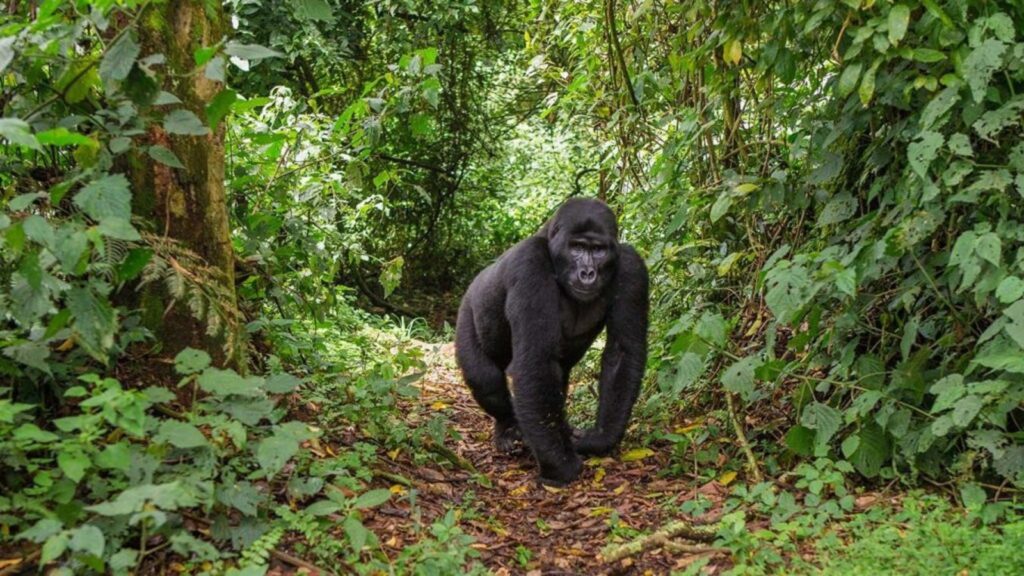
Silverbacks play important roles within mountain gorilla families.
A dominant male can lead group movements, protect members, respond to threats, and intervene in social conflicts.
Other mature males may also contribute to family protection and stability.
Leadership can change naturally when a dominant silverback ages, dies, or loses influence.
The Kwitonda family has therefore experienced leadership changes throughout its history.
Visitors may observe silverbacks chest beating, vocalizing, displaying their size, or shaking vegetation.
These behaviors form part of natural gorilla communication.
Kwitonda Blackbacks
Blackbacks are younger males that have not yet developed the characteristic silver hair of mature silverbacks.
They may spend time playing, wrestling, climbing, feeding, and interacting with other members.
As they mature, some males remain with their family while others leave.
Those that leave may eventually establish new social groups or join other families.
This process helps explain why gorilla family structures can change considerably over time.
Kwitonda Adult Females
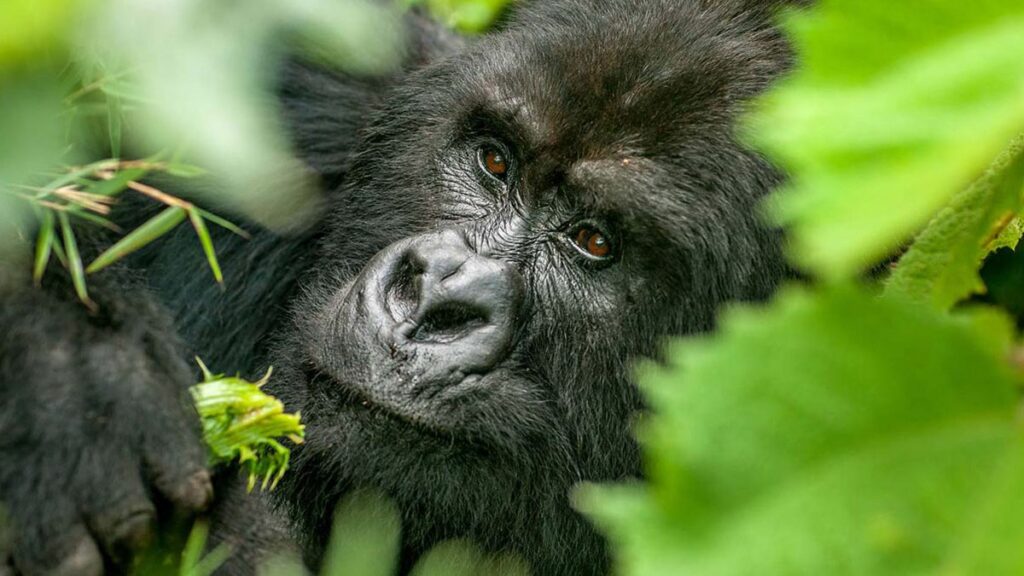
Adult females are important members of the Kwitonda family.
They contribute to reproduction and the care of infants and juveniles.
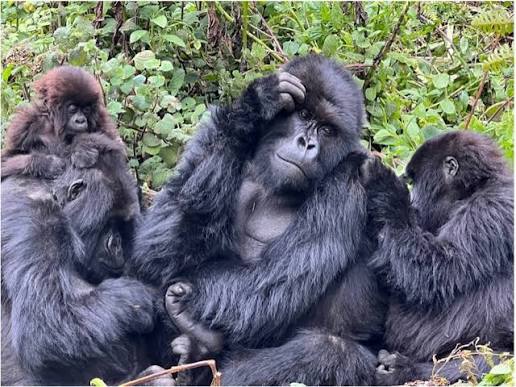
Visitors may observe females feeding, grooming, resting, carrying infants, or interacting with other members.
Female gorillas can transfer between social groups.
These movements help maintain social connections and genetic diversity within the wider mountain gorilla population.
Kwitonda Infants and Juveniles
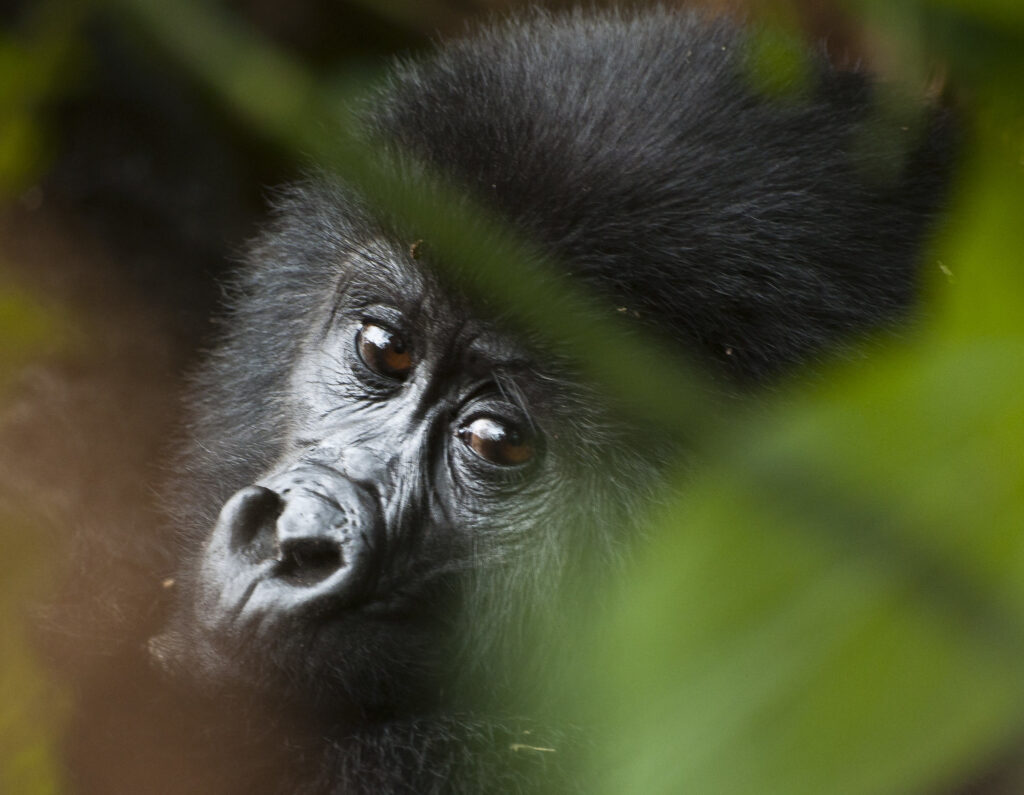
Infants and juveniles are among the most active members of a gorilla family.
Infants normally remain close to their mothers during early development.
As they grow, young gorillas become increasingly independent.
Juveniles may climb, wrestle, chase each other, and imitate adult behavior.
Play helps them develop strength, coordination, and social skills.
Visitors should observe young gorillas quietly and avoid attempting to attract their attention.
How Large Is the Kwitonda Gorilla Group?
The size of the Kwitonda family changes naturally.
Births can increase its population, while deaths, transfers, and group divisions can reduce it.
Historical records may therefore show different numbers for the family.
Travelers should not rely on an old figure as a permanent measure of the group’s size.
Current family composition should be confirmed through up-to-date conservation or tourism information before a trek.
Is Kwitonda Open for Gorilla Trekking?
Kwitonda has been one of the habituated gorilla families associated with tourism in Volcanoes National Park.
However, family availability can change according to conservation management, group condition, and tourism arrangements.
Travelers who specifically want to trek Kwitonda should confirm its current status before booking.
A reputable tour operator can check current permit availability and explain the latest family allocation procedures.
Can You Request the Kwitonda Gorilla Group?
Travelers can communicate a preference for the Kwitonda group when arranging their trek.
However, a request does not guarantee assignment.
Wildlife authorities manage gorilla family allocation based on availability, conservation requirements, and operational considerations.
If Kwitonda is your preferred family, tell your tour operator early in the booking process.
Kwitonda Gorilla Trekking Experience
A Kwitonda trek begins with registration and a pre-trekking briefing at the designated Volcanoes National Park headquarters.
Visitors receive instructions about safety, conservation, photography, and behavior around the gorillas.
Guides and trackers then lead the group into the forest.
The distance required to locate Kwitonda depends on where the family is located on that particular day.
The trek may therefore be relatively short on one day and considerably longer on another.
How Difficult Is a Kwitonda Gorilla Trek?
The Kwitonda trek can be physically demanding.
Volcanoes National Park contains steep volcanic terrain, dense vegetation, bamboo forests, muddy trails, and high-altitude conditions.
Rain can make trails slippery.
Travelers should prepare physically before the safari by walking regularly and practicing on hills or uneven ground.
Hiring a porter can provide additional support during difficult sections of the trek.
How Long Does Kwitonda Trekking Take?
There is no fixed duration for a Kwitonda trek.
Trackers determine the family’s location using signs such as nests, feeding areas, trails, and vegetation disturbance.
The hiking time depends on how far the gorillas have moved and the terrain between the starting point and their location.
Once visitors find the family, they spend the regulated observation period with the gorillas.
The group then returns through the forest.
Best Time to Trek the Kwitonda Group
Kwitonda can be visited during the year-round gorilla trekking season.
Many travelers prefer relatively dry periods because trails may be easier to navigate.
However, rainfall occurs throughout the year in the Virunga Mountains.
Wet conditions can make the trails muddy but also produce lush vegetation and dramatic mountain scenery.
The best travel period depends on your weather preferences, budget, accommodation availability, and wider Rwanda itinerary.
Kwitonda Gorilla Habituation
Habituation is the gradual process through which wild gorillas become accustomed to controlled human presence.
It allows researchers, trackers, and authorized tourists to observe gorillas while maintaining conservation safeguards.
Habituated gorillas remain wild animals.
Visitors should never treat them like domesticated animals or attempt to interact physically with them.
Following the guide’s instructions helps minimize stress and disturbance.
Kwitonda Gorilla Group and Conservation
The Kwitonda family forms part of Rwanda’s wider mountain gorilla conservation program.
Researchers and trackers monitor gorilla families over long periods.
They collect information about health, reproduction, births, deaths, movements, behavior, and social relationships.
Gorilla tourism also supports conservation through permit revenue and employment.
Guides, trackers, rangers, porters, drivers, lodge workers, and other tourism professionals benefit from the industry surrounding Volcanoes National Park.
Kwitonda and the Virunga Ecosystem
Kwitonda is part of the mountain gorilla population of the wider Virunga ecosystem.
The ecosystem extends across Rwanda, Uganda, and the Democratic Republic of Congo.
The forest provides food, shelter, breeding habitat, and movement corridors for mountain gorillas.
Protecting the wider ecosystem is essential for the long-term survival of the species.
Cross-border conservation efforts also help maintain suitable habitat for the mountain gorilla population.
Gorilla Trekking Rules for Kwitonda
Visitors must follow the instructions provided during the pre-trekking briefing.
Maintain the required distance from the gorillas.
Never touch or feed them.
Keep voices low and avoid sudden movements.
Do not use flash photography.
Visitors showing signs of potentially infectious illness should not enter the gorilla habitat.
These rules protect both gorillas and visitors.
Can You Photograph Kwitonda Gorillas?
Photography is permitted during authorized encounters.
Visitors should avoid flash photography.
Do not move closer to the gorillas simply to obtain a better photograph.
A camera with an appropriate zoom lens can help capture detailed images while maintaining the required distance.
Follow the guide’s instructions if a gorilla approaches the group or changes direction.
Hiring a Porter for a Kwitonda Trek
Hiring a porter can make the trek more comfortable.
Porters can carry backpacks, water, cameras, and other personal belongings.
They can also provide assistance on steep or slippery trails.
Hiring a porter provides direct income to communities around Volcanoes National Park.
It therefore combines practical trekking support with local economic benefits.
What Should You Pack for a Kwitonda Trek?
Prepare for cool, wet, and muddy mountain conditions.
Wear sturdy hiking boots with good traction.
Long trousers and long-sleeved clothing can protect your skin from vegetation and insects.
Carry a waterproof jacket, drinking water, a small backpack, and camera equipment.
Use waterproof protection for phones and cameras.
Gardening gloves can protect your hands when moving through dense vegetation.
A walking stick can provide additional support on steep trails.
When Should You Arrive for the Kwitonda Trek?
Arrive at the designated trekking headquarters early enough for registration and briefing.
Your tour operator should provide the exact reporting time.
Early arrival gives you time to organize your equipment, meet your guide, and prepare for the hike.
It also reduces the risk of delays before entering the forest.
Kwitonda Gorilla Trekking Cost
The gorilla permit represents the main mandatory expense.
The total cost of a Kwitonda safari also depends on accommodation, transportation, meals, porter services, flights, and additional activities.
Permit prices and other tourism charges can change.
Travelers should therefore confirm current prices before booking.
A complete safari quotation provides a clearer picture of the total trip cost.
How to Book a Kwitonda Gorilla Trek
Start by selecting your preferred travel dates.
Ask a reputable tour operator to check current gorilla permit availability.
If you specifically prefer Kwitonda, communicate this preference during the booking process.
Remember that family allocation is controlled by wildlife authorities and cannot necessarily be guaranteed.
Once the permit is secured, arrange accommodation, transportation, and other activities around your trekking date.
Kwitonda Compared With Other Rwandan Gorilla Groups
Kwitonda is one of several famous habituated gorilla families in Volcanoes National Park.
Other recognized groups include Susa, Sabyinyo, Amahoro, Agashya, Umubano, Hirwa, and Karisimbi.
Kwitonda stands out because of its connection with the silverback after whom the family was named and its historical link with the Susa family.
Each gorilla family has its own social history and composition.
The actual trekking experience depends on the group’s location and behavior on the day of the visit.
Frequently Asked Questions
What does Kwitonda mean?
Kwitonda means “the humble one” in Kinyarwanda.
Where is the Kwitonda gorilla group?
Kwitonda is associated with Volcanoes National Park in northwestern Rwanda.
Who was Kwitonda?
Kwitonda was a silverback whose leadership and movements played an important role in establishing the family that bears his name.
Was Kwitonda connected to the Susa group?
Yes. The history of the Kwitonda family is connected with the Susa gorilla group, from which the original silverback Kwitonda departed.
Is Kwitonda available for gorilla trekking?
Kwitonda has been a habituated gorilla family associated with tourism. Confirm its current trekking status before booking.
Can I request the Kwitonda group?
You can communicate a preference, but wildlife authorities control final family allocation and cannot necessarily guarantee a particular group.
How large is the Kwitonda family?
Its size changes naturally through births, deaths, transfers, and other social developments.
How difficult is the Kwitonda trek?
The trek can be physically demanding because of steep terrain, dense vegetation, muddy trails, and changing weather.
How long does the Kwitonda trek take?
There is no fixed duration. Hiking time depends on the family’s location and movements.
Can I photograph Kwitonda gorillas?
Yes. Photography is allowed during authorized encounters, but flash photography should be avoided.
Can I touch a Kwitonda gorilla?
No. Visitors should never intentionally touch the gorillas.
Should I hire a porter?
Hiring a porter can make the trek easier while providing economic support to local communities.
Can I trek Kwitonda if I am sick?
Visitors showing signs of potentially infectious illness should not enter the gorilla habitat. Inform your tour operator and follow current health procedures.
Conclusion
The Kwitonda gorilla group in Rwanda is a fascinating mountain gorilla family with a history closely connected to the famous Susa group and the silverback after whom it was named.
The name Kwitonda, meaning “the humble one,” reflects the historical identity of a silverback whose departure from Susa contributed to the establishment of a new gorilla family.
The family’s history demonstrates the dynamic nature of mountain gorilla societies. Births, deaths, transfers, leadership changes, and social relationships continually influence the composition of the group.
For travelers, trekking Kwitonda provides an opportunity to observe endangered mountain gorillas in their natural habitat while supporting conservation and local communities.
Travelers should confirm the family’s current status and permit availability before booking. They should also prepare for steep terrain, changing weather, and potentially long hikes.
During the gorilla encounter, maintain the required distance, avoid flash photography, never touch or feed the animals, and follow the instructions of the guide.
A responsible Kwitonda gorilla group Rwanda experience combines wildlife adventure, conservation education, and support for the communities surrounding Volcanoes National Park.