Gorilla Intelligence Facts for Trekkers: How Smart Are Gorillas?
Learning gorilla intelligence facts can completely change the way visitors view mountain gorillas during a trekking experience. These powerful great apes are not simply large forest animals. They display complex social behavior, problem-solving abilities, communication skills, memory, emotional responses, and learning abilities.
Mountain gorillas share many characteristics with humans because they are one of our closest living relatives. Their intelligence is expressed differently from human intelligence, but careful observation reveals sophisticated behaviors throughout their daily lives.
During gorilla trekking in Uganda, Rwanda, or the Democratic Republic of Congo, visitors may see gorillas communicating with one another, caring for infants, using their surroundings, solving simple problems, learning from older group members, and adapting their behavior to different situations.
Understanding these behaviors makes a gorilla encounter more meaningful. Instead of simply watching a silverback, mother, juvenile, or infant, trekkers can begin to recognize the intelligence behind the animal’s actions.
How Intelligent Are Gorillas?
Gorillas are highly intelligent great apes.
They demonstrate the ability to learn from experience, remember individuals and locations, communicate socially, solve problems, and adapt to changing circumstances.
Their intelligence is particularly visible in their social lives.
Gorillas must understand relationships within their group, recognize individual members, respond appropriately to different social situations, and learn behaviors from older animals.
This combination of memory, learning, communication, and social awareness demonstrates considerable cognitive ability.
Gorilla Intelligence and Their Human Relatives
Gorillas are great apes, along with chimpanzees, bonobos, orangutans, and humans.
Their evolutionary relationship with humans helps explain why gorillas display several behaviors that appear familiar to us.
They form strong family relationships, care for the young, communicate emotions, cooperate socially, and learn through observation.
However, gorilla intelligence should not be judged solely by human standards.
Their abilities have evolved to help them survive within complex forest environments and social groups.
Gorillas Can Learn From Experience
One of the most important gorilla intelligence facts is their ability to learn.
Young gorillas observe adults and gradually develop important skills.
They watch how adults feed, move through vegetation, communicate, groom one another, and respond to potential threats.
Through repeated observation and practice, juveniles become more capable.
This type of social learning allows knowledge to pass between generations.
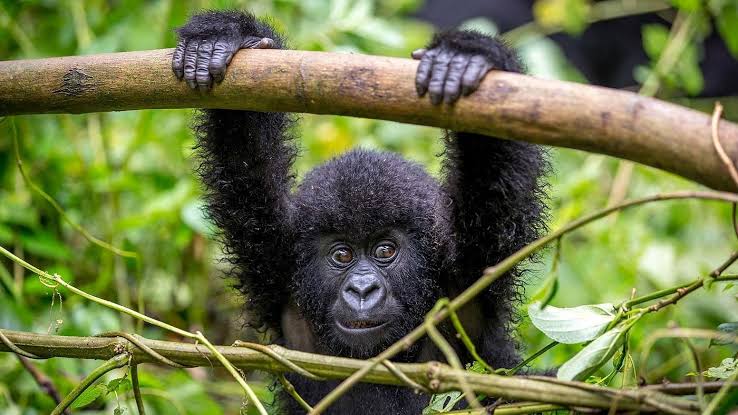
Baby Gorillas Learn Through Observation
Young gorillas are particularly good examples of learning behavior.
An infant begins life highly dependent on its mother but gradually becomes more independent.
It watches adults closely and experiments with behaviors it observes.
A juvenile may copy feeding movements, grooming behavior, climbing techniques, or social interactions.
Play also provides opportunities to practice physical and social skills.
Gorillas Have Strong Memories
Gorillas can remember individuals and important aspects of their environment.
Recognizing family members is essential for maintaining stable social relationships.
They also need to remember feeding areas, movement routes, nesting locations, and other features of their home range.
Long-term memory therefore plays an important role in their survival.
Gorillas Recognize Individual Group Members
A gorilla family can contain numerous individuals.
Members need to distinguish between different gorillas and understand their relationships.
Gorillas recognize familiar individuals through appearance, sounds, behavior, and social interactions.
This recognition helps maintain the group’s social organization.
Gorillas Understand Social Relationships
Gorilla society is complex.
Individuals occupy different social positions and maintain different relationships with other members.
The dominant silverback has a particularly important position, while females, subordinate males, juveniles, and infants have their own relationships within the group.
Gorillas must therefore understand who belongs to their group and how they should interact with different individuals.
This social awareness is an important aspect of gorilla intelligence.
Gorillas Communicate With One Another
Gorilla communication involves vocalizations, facial expressions, body posture, gestures, and physical contact.
Different sounds can occur during feeding, grooming, movement, play, excitement, or tense situations.
Gorillas also use body language to communicate their intentions.
Understanding these signals helps members of the group coordinate their activities and maintain social relationships.
Gorillas Use Body Language
Communication does not depend entirely on vocalizations.
A gorilla may change its posture, facial expression, movement, or position to communicate.
A silverback may use a powerful display to communicate strength.
A mother may use physical contact to reassure an infant.
Juveniles may use body movements during play.
These behaviors demonstrate that gorilla communication is multimodal.
Silverbacks Make Decisions for the Group
The dominant silverback often plays an important role in group movement.
He may initiate travel between feeding and resting areas.
Other members follow or remain close to the group.
The silverback also responds to potential threats and may decide how the group reacts.
This leadership requires awareness of the group’s condition and surrounding environment.
Gorillas Can Solve Problems
Gorillas can solve practical problems encountered in their environment.
They may manipulate vegetation to access food, move obstacles, reach desirable plant material, or navigate challenging terrain.
Captive studies have also demonstrated problem-solving abilities in gorillas.
These skills illustrate their capacity to understand relationships between actions and outcomes.
Do Gorillas Use Tools?
Gorillas are capable of using objects in practical ways, although tool use is not as frequently documented in wild gorillas as it is in chimpanzees.
They can manipulate branches and other objects to interact with their environment.
In captivity, gorillas have demonstrated the ability to use objects for specific tasks.
Their relatively limited tool use in the wild may partly reflect the fact that their natural diet is accessible without sophisticated tools.
Gorillas Understand Cause and Effect
Gorillas can learn that particular actions produce particular results.
For example, a gorilla may learn how to manipulate vegetation to access food.
Repeated experiences allow individuals to improve their behavior.
This ability to learn from consequences is an important component of animal intelligence.
Gorillas Can Adapt Their Behavior
Mountain gorillas live in a changing environment.
Food availability, weather, terrain, group composition, and potential threats can vary.
Gorillas adjust their movements and behavior accordingly.
They may change feeding locations, alter travel routes, or respond differently to disturbances.
Behavioral flexibility helps them survive in their natural environment.
Gorillas Have Individual Personalities
Another fascinating gorilla intelligence fact is that individual gorillas display distinct personalities.
Some may be more curious and adventurous.
Others can appear calm, cautious, playful, or dominant.
These individual differences influence how gorillas interact with family members, their environment, and occasionally human observers.
Personality is closely connected to behavior and social relationships.
Gorillas Show Emotional Responses
Gorillas display behaviors associated with a range of emotional states.
They can appear relaxed, excited, playful, distressed, curious, or agitated.
Their reactions can be seen through facial expressions, vocalizations, body posture, and interactions with other gorillas.
Visitors should remember that emotional responses are another reason to observe the animals respectfully.
Gorillas Show Affection Through Social Contact
Gorillas maintain close relationships through grooming, touching, resting together, and other forms of social contact.
Mothers maintain particularly strong bonds with their infants.
Adults may also groom one another for extended periods.
These interactions reinforce social relationships and demonstrate the importance of social connection within gorilla families.
Gorillas Learn Social Rules
Young gorillas do not automatically know how to behave within their group.
They learn through observation and interaction.
Play allows juveniles to practice appropriate social behavior.
Adults can respond when younger animals behave inappropriately.
Over time, young gorillas learn how to interact with different members of the family.
This social learning is an important component of their cognitive development.
Gorillas Can Recognize Familiar Humans
Habituated gorillas can become familiar with the presence of researchers, trackers, and guides who regularly monitor them.
However, habituation does not mean domestication.
The gorillas remain wild animals.
Their ability to recognize familiar humans demonstrates memory and learning, but visitors should never assume that habituated gorillas are tame.
Gorillas Can Learn Human Communication Signals
Gorillas under human care have demonstrated impressive abilities to learn gestures and other forms of communication.
Some individuals have learned symbolic systems or human-directed communication in research settings.
These studies provide evidence of sophisticated cognitive abilities.
However, captive research should not be confused with ordinary behavior observed during a wild gorilla trekking experience.
Gorillas Can Understand Simple Instructions
Research with gorillas under human care has shown that some individuals can learn to respond to human instructions and symbols.
These abilities demonstrate learning, memory, and association.
Wild mountain gorillas, however, are not trained performers.
During trekking, visitors should observe natural behavior rather than attempt to communicate with the animals.
Gorilla Intelligence and Problem-Solving in the Forest
The forest presents many practical challenges.
Gorillas need to find food, move through dense vegetation, build nests, maintain social relationships, and respond to environmental changes.
They accomplish these tasks without human assistance.
Their ability to navigate such an environment demonstrates the practical intelligence required for survival.
Gorillas Learn From Older Group Members
Older gorillas provide an important source of knowledge.
Young animals observe adults and gradually acquire behaviors through imitation and experience.
This allows useful knowledge to remain within the group.
Social learning may help younger gorillas develop feeding, communication, movement, and social skills.
Why Gorilla Intelligence Matters During Trekking
Understanding gorilla intelligence can change what visitors look for during an encounter.
Instead of focusing only on size or appearance, trekkers can observe relationships and decision-making.
Watch how a mother responds to her infant.
Observe how juveniles learn through play.
Notice how the silverback monitors the group.
Pay attention to how gorillas communicate without words.
These behaviors reveal the complexity of their social and cognitive lives.
Should Visitors Try to Test Gorilla Intelligence?
No.
Visitors should never attempt experiments or deliberately create situations to test a gorilla’s intelligence.
Do not offer objects.
Do not make unusual sounds.
Do not attempt to attract an animal.
Do not give food.
The best way to appreciate gorilla intelligence is through passive observation.
Gorilla Intelligence and Responsible Tourism
Respectful tourism allows gorillas to maintain their natural behavior.
Visitors should follow trekking regulations, maintain the required distance, avoid sudden movements, and listen to guides.
These measures reduce stress and help protect the animals.
Responsible tourism also supports conservation programs that protect gorillas and their forest habitat.
Why Gorillas Are Important to Conservation
Gorillas are highly intelligent and socially complex animals, making their conservation especially important.
Protecting them means preserving not only a species but also a unique form of animal social and cognitive behavior.
Mountain gorilla conservation protects the forests in which these animals live and supports communities around protected areas.
Tourism can contribute to these efforts when managed responsibly.
Gorilla Intelligence Compared With Other Great Apes
Gorillas share many cognitive characteristics with other great apes.
Chimpanzees are particularly well known for sophisticated tool use and problem-solving.
Orangutans demonstrate impressive memory and problem-solving skills.
Gorillas also show strong social intelligence, learning ability, memory, and problem-solving.
Each species has developed abilities suited to its ecological and social environment.
Conclusion
These gorilla intelligence facts reveal that mountain gorillas are much more cognitively complex than their impressive physical appearance might suggest. They can learn from experience, recognize individuals, remember important aspects of their environment, communicate through sounds and body language, solve practical problems, and develop strong social relationships.
Young gorillas learn by watching older members of their family, while adults use experience and social awareness to navigate their environment. Silverbacks monitor their groups and respond to changing situations, while mothers teach and protect their young.
For trekkers, observing these behaviors can make a gorilla encounter much more meaningful. Instead of simply seeing a large primate feeding in the forest, visitors can appreciate an intelligent animal participating in a complex social society.
The most respectful way to experience gorilla intelligence is through quiet observation. Visitors should never attempt to test, feed, touch, or deliberately communicate with the animals.
By protecting gorillas and their forest habitat, conservation programs help ensure that these remarkable examples of great ape intelligence continue to survive for future generations.