
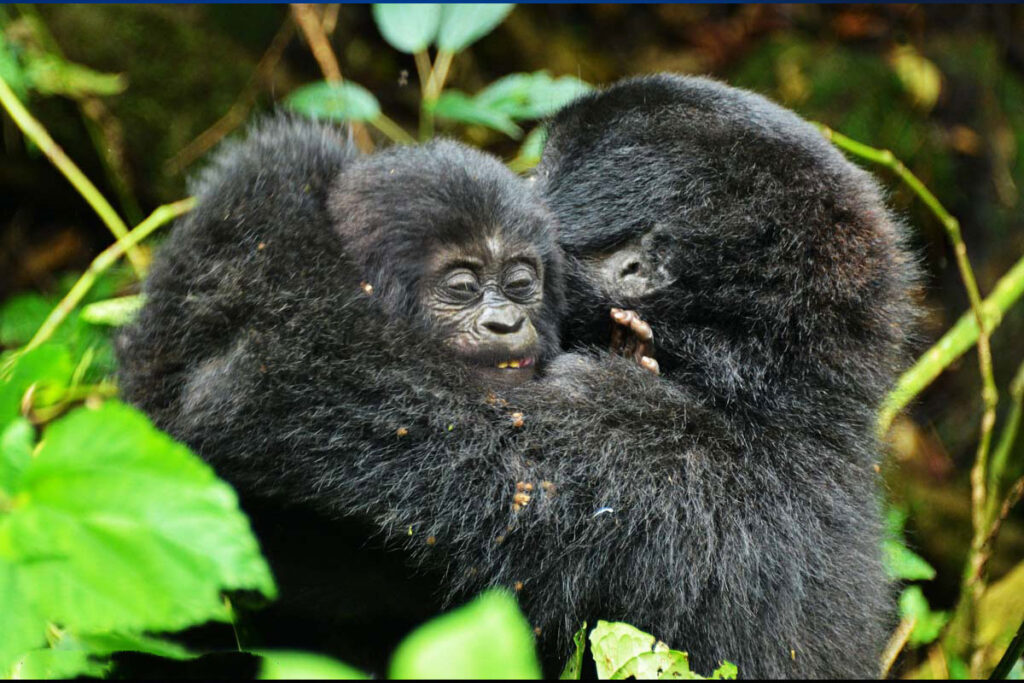
Infant Gorilla Development Stages: From Birth to Independence
The life of a gorilla begins with complete dependence on its mother. Like human babies, infant gorillas require years of care, protection, and learning before they can survive independently within their family group. Their development follows a gradual process that includes physical growth, social learning, play, and increasing independence.
Whether in Mountain Gorilla, Eastern Lowland Gorilla, or Western Lowland Gorilla populations, infant development follows remarkably similar patterns. Throughout these stages, mothers provide constant care while the silverback and other group members contribute to the infant’s safety and social environment.
Understanding infant gorilla development offers valuable insight into the complex social lives of these great apes and highlights the importance of strong family bonds within gorilla groups.
Birth and the Newborn Stage (0–3 Months)
A Fragile Beginning
An infant gorilla typically weighs between 1.5 and 2 kilograms at birth. Compared to the size of an adult gorilla, newborns are extremely small and vulnerable.
During the first few weeks of life, the infant remains almost constantly attached to its mother’s chest. The mother supports the baby while moving, feeding, and resting.
At this stage, the infant has limited muscle control and depends entirely on its mother for warmth, nourishment, and protection.
Early Physical Development
The newborn’s eyes remain open shortly after birth, allowing it to observe its surroundings. However, movement remains limited.
The infant spends most of its time nursing and sleeping. During this period, rapid growth occurs as the baby gains strength and develops coordination.
The close physical bond established during these first months becomes essential for emotional security and survival.
Early Infancy (3–6 Months)
Developing Strength and Awareness
By three months of age, infant gorillas begin showing greater awareness of their environment.
They become more active and start observing other members of the group. Their grip strengthens significantly, allowing them to cling more securely to their mothers while traveling.
The infant also begins responding to sounds, movements, and social interactions within the group.
First Social Interactions
At this stage, curiosity begins to emerge. Infants start reaching toward nearby objects, vegetation, and occasionally other gorillas.
Although they remain close to their mothers, they begin learning through observation. Watching older siblings and juveniles provides important lessons about social behavior and group dynamics.
Exploration Stage (6–12 Months)
Growing Independence
Between six and twelve months, infant gorillas become increasingly adventurous.
They begin spending short periods away from their mother’s body while remaining within arm’s reach. Crawling, climbing, and exploring nearby vegetation become common activities.
This stage marks the beginning of independent movement.
Learning Through Play
Play becomes an essential part of development during this period.
Infants experiment with balance, strength, and coordination by climbing small branches, chasing siblings, and interacting with objects.
Play behavior also supports cognitive development and helps young gorillas understand social rules.
Mothers continue to supervise closely, often intervening if the infant ventures too far.
Juvenile Transition Stage (1–3 Years)
Increased Mobility
By their first birthday, most gorillas move confidently on their own.
They walk, climb, and explore larger areas around the group. Although they still rely heavily on their mothers, they no longer remain in constant physical contact.
Nursing continues, but solid foods become a growing part of the diet.
Expanding Social Relationships
Young gorillas begin interacting more frequently with siblings, cousins, and other juveniles.
These interactions include wrestling, chasing, mock fighting, and climbing games. Such activities help develop physical skills and establish social competence.
Young gorillas also learn group etiquette, including communication signals and acceptable social behavior.
Learning Survival Skills
During this stage, juveniles learn which plants are edible, how to build nests, and how to navigate the forest.
Much of this learning occurs through observation rather than direct instruction.
The mother remains the primary teacher, but the entire group contributes to the learning environment.
Young Juvenile Stage (3–6 Years)
Growing Confidence
As gorillas enter the young juvenile stage, they become increasingly independent.
They spend much of the day playing with peers and exploring the surrounding environment.
Although nursing may still occur occasionally, most nutritional needs come from vegetation and other natural food sources.
Strong Social Development
This period plays a crucial role in social growth.
Young gorillas develop friendships, learn conflict resolution, and strengthen communication skills. Play fighting becomes more sophisticated and helps prepare them for adult social interactions.
They also begin forming relationships with the silverback and other adult group members.
Physical Growth Accelerates
Body size increases steadily during these years.
Muscles become stronger, coordination improves, and climbing ability becomes more advanced.
The playful behavior seen during this stage contributes significantly to physical conditioning.
Subadult Stage (6–8 Years)
Transition Toward Adulthood
Between six and eight years of age, gorillas enter the subadult phase.
Physical growth continues rapidly, and behavioral patterns become more mature.
Females often show calmer behavior and begin integrating more closely with adult females in the group.
Males become increasingly interested in establishing social status and testing their strength through play and displays.
Reduced Dependence on Mothers
By this stage, gorillas no longer depend on their mothers for food or protection.
However, strong family bonds remain important, and many young gorillas continue spending significant time near their mothers.
This gradual separation allows individuals to gain confidence while maintaining social security.
Adolescent Development (8–12 Years)
Female Maturity
Female gorillas typically reach sexual maturity between eight and ten years of age.
As they mature, they may remain within their birth group or eventually transfer to another group to breed.
Their social roles become more defined, and they begin preparing for motherhood.
Male Development
Male gorillas mature more slowly than females.
During adolescence, males grow larger and stronger but have not yet developed the characteristic silver hair associated with mature silverbacks.
Many young males eventually leave their birth group and spend years living alone or in bachelor groups before establishing their own families.
The Role of Mothers in Development
Throughout every stage of development, the mother remains the most important figure in an infant gorilla’s life.
She provides nourishment, protection, emotional security, and guidance.
The mother teaches essential survival skills simply through daily interaction and example.
The bond between mother and infant often lasts for many years and forms the foundation of successful development.
The Importance of the Silverback
Although mothers provide direct care, the silverback also plays a crucial role.
He protects the group from threats and creates a stable social environment where infants can grow safely.
Many silverbacks show remarkable tolerance toward young gorillas and often allow them to climb, play, and interact nearby.
His presence significantly increases infant survival rates.
Conclusion
Infant gorilla development is a long and complex journey that mirrors many aspects of human childhood. From complete dependence at birth to increasing independence and social maturity, each stage plays a vital role in preparing young gorillas for life within their family group.
Mothers provide constant care, while the silverback and other group members contribute to protection and social learning. Through play, observation, and experience, young gorillas acquire the physical and social skills necessary for adulthood.
These developmental stages highlight the intelligence, emotional depth, and strong family bonds that make gorillas among the most fascinating animals on Earth.



