Gorilla Vocalisations Meaning: Understanding How Gorillas Communicate
Understanding gorilla vocalizations’ meaning can make a mountain gorilla trekking experience much more fascinating. Gorillas communicate constantly through sounds, body movements, facial expressions, posture, and physical interactions. Although some gorilla vocalizations may sound similar to human noises, they can communicate very different messages depending on the situation.
Mountain gorillas live in closely connected social groups, making communication essential for maintaining relationships, coordinating movement, expressing emotions, and responding to potential threats. During trekking, visitors may hear gorillas grunting, humming, barking, screaming, or making other sounds as they feed, rest, move, or interact with group members.
Not every vocalization has one fixed meaning. The same type of sound can have different meanings depending on the context, the individual producing it, and what is happening around the group.
This guide explains the most common mountain gorilla vocalizations travelers may encounter and what they can mean during a trekking experience.
How Do Mountain Gorillas Communicate?
Mountain gorillas use several forms of communication.
Vocalizations are one important part of their communication system, but they also rely heavily on body language and facial expressions.
A gorilla may combine a sound with a particular posture or movement to communicate a stronger message.
For example, a vocalization accompanied by relaxed feeding behavior may have a very different meaning from the same sound produced during a tense interaction.
This is why experienced gorilla guides and trackers pay attention to the entire situation rather than interpreting one sound on its own.
Why Gorilla Vocalisations Matter
Communication helps gorillas maintain their social groups.
A gorilla family may contain a dominant silverback, adult females, younger males, juveniles, and infants. Members need to communicate while feeding, traveling, resting, and interacting.
Vocalizations can help individuals maintain contact, express reassurance, show excitement, respond to other group members, or signal discomfort.
Sounds can also help gorillas communicate when dense vegetation makes visual contact difficult.
Gorilla Grunting Meaning
Grunting is one of the vocalizations visitors may hear most frequently.
A gorilla can produce soft or louder grunts while feeding, moving, or interacting with other members of the group.
Grunts can serve as contact or social signals.
A relaxed gorilla may grunt while continuing to feed without showing any sign of distress.
Visitors should therefore not automatically interpret every grunt as aggression.
Gorilla Humming Meaning
Gorillas may produce soft humming or rumbling sounds while feeding.
These sounds can occur when the animals are relaxed and engaged in their normal activities.
Humming can therefore be a fascinating indication that visitors are observing natural social or feeding behavior.
A gorilla humming while calmly eating vegetation is generally very different from an animal producing louder sounds during a tense interaction.
Gorilla Belch Vocalisation
Gorillas are known for producing distinctive belch-like vocalizations.
These sounds can occur during relaxed social situations and may function as affiliative or reassuring signals.
The sound can sometimes appear surprising to visitors because it resembles a human belch.
However, within gorilla communication, it can form part of normal social interaction.
Gorilla Barks and Short Calls
Gorillas can produce short, sharp calls that may sound like barking.
These vocalizations can be associated with attention, alertness, or interactions between individuals.
The meaning depends on the surrounding circumstances.
A guide may explain whether the gorilla is responding to another group member, an environmental disturbance, or something else.
Gorilla Screams and Loud Vocalisations
Loud screams or intense vocalizations can indicate excitement, distress, conflict, or agitation.
Visitors should pay particular attention when a gorilla’s vocal behavior becomes significantly louder or more intense.
However, a loud sound alone does not provide enough information to determine exactly what the gorilla is communicating.
The animal’s posture, movement, facial expression, and interaction with other gorillas should also be considered.
Gorilla Roaring and Deep Sounds
Large adult males can produce powerful low-frequency sounds.
These sounds may occur during displays, social interactions, or situations where the gorilla is communicating its presence.
A deep vocalization can sound intimidating to visitors, especially when produced by a silverback at close range.
However, the sound does not automatically mean that an attack is imminent.
Visitors should remain calm and follow the guide’s instructions.
Gorilla Chest-Beat Sounds
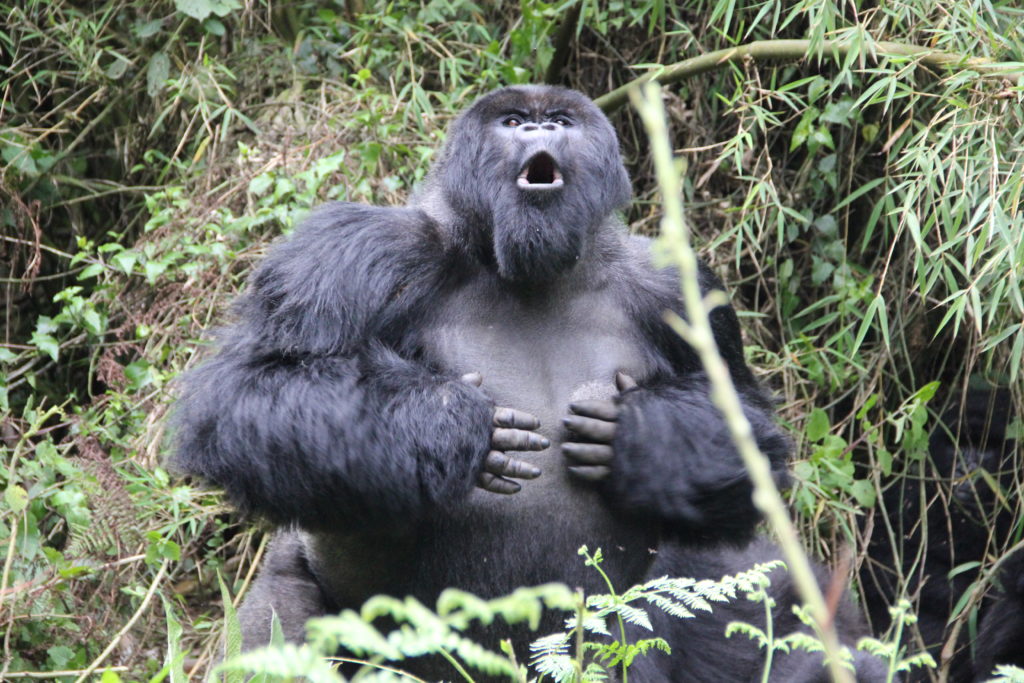
Chest beating produces a distinctive sound that can accompany vocal communication.
A silverback may beat his chest while making other sounds or displaying particular body postures.
The combination can communicate strength, excitement, social information, or a warning.
Visitors should never imitate chest beating or attempt to encourage the gorilla to repeat the behavior.
Gorilla Vocalisations During Feeding
Feeding is often accompanied by quiet vocalizations.
Gorillas may grunt, hum, or produce other soft sounds while eating.
These sounds can help maintain social contact within the group.
A visitor who quietly observes a feeding group may hear a surprising variety of subtle sounds.
This is one reason guides encourage travelers to remain quiet during the encounter.
Gorilla Vocalisations During Grooming
Grooming is an important social activity.
Gorillas may make soft sounds while grooming or being groomed by another group member.
These vocalizations can accompany relaxed social interactions.
The behavior demonstrates that communication is closely connected with relationships within the group.
Gorilla Vocalisations During Play
Young gorillas can be particularly expressive.
Juveniles may make sounds while chasing, wrestling, climbing, or interacting with other young gorillas.
These vocalizations may accompany excitement and playful interactions.
Visitors should allow the juveniles to continue playing naturally without attempting to attract their attention.
Gorilla Mother and Infant Vocalisations
Mothers and infants use communication to maintain close contact.
Infants can make various sounds when seeking attention, food, reassurance, or physical contact.
Mothers respond through vocalizations, physical contact, movement, and other behaviors.
These interactions can provide visitors with a fascinating view of family relationships within the gorilla group.
Gorilla Vocalisations and Social Bonding
Communication helps strengthen relationships between gorilla group members.
Soft vocalizations can accompany grooming, resting, feeding, and other peaceful social activities.
These sounds help maintain cohesion within the group.
Gorilla communication is therefore not limited to warnings or aggressive displays.
Much of it occurs during ordinary daily activities.
Gorilla Vocalisations and Aggression
Some vocalizations can occur during tense interactions.
A gorilla may become louder, change its posture, move rapidly, or combine vocalizations with chest beating.
These signals may indicate agitation or a defensive response.
Visitors should never attempt to determine whether the animal is aggressive by sound alone.
If behavior changes, follow the guide immediately.
Can Humans Understand Gorilla Language?
Humans cannot translate gorilla vocalizations into a simple dictionary where every sound has one exact meaning.
Researchers can identify patterns and associate particular vocalizations with different social contexts.
However, communication is complex.
The meaning of a sound can depend on who produces it, who hears it, the surrounding situation, and other behaviors occurring at the same time.
This makes gorilla communication an interesting area of scientific research.
Do Gorillas Have Different Calls for Different Situations?
Yes, gorillas use different vocalizations in different contexts.
Sounds can accompany feeding, movement, social interaction, play, distress, excitement, or potential threats.
However, it is more accurate to think of gorilla communication as a flexible system rather than a simple collection of fixed words.
Body language and social context help complete the message.
How Guides Interpret Gorilla Sounds
Experienced guides and trackers develop strong familiarity with the gorilla families they monitor.
They can recognize common vocalizations and understand them in relation to the animals’ behavior.
They also watch body posture, facial expressions, movement, and interactions between group members.
This allows them to make informed judgments about what is happening during an encounter.
Visitors should therefore listen to the guide when a gorilla produces an unfamiliar or intense sound.
What Should You Do When a Gorilla Vocalizes?
Remain calm and quiet.
Do not imitate the sound.
Do not shout back.
Do not attempt to attract the gorilla’s attention.
Observe the animal from the required distance and listen to your guide.
If the gorilla’s behavior changes, follow the guide’s instructions immediately.
Gorilla Vocalisations and Visitor Safety
Vocalizations can provide useful clues about the animals’ behavior, but visitors should never rely on sound alone to assess safety.
A quiet gorilla can still be a wild animal.
A loud gorilla is not necessarily preparing to attack.
The safest approach is to follow established trekking rules throughout the encounter.
Gorilla Vocalisations and Responsible Tourism
Responsible tourism means allowing gorillas to communicate naturally.
Visitors should not make artificial sounds, play recordings, or deliberately provoke reactions.
Trying to make a gorilla vocalize for a photograph or video can interfere with natural behavior.
Quiet observation provides a more authentic experience.
Gorilla Vocalisations and Photography
Sounds can make a gorilla encounter particularly memorable.
Visitors may want to record the experience, but equipment should never interfere with the animals.
Keep cameras and phones secure.
Avoid sudden movements while filming.
Do not move closer because a gorilla produces an interesting sound.
The welfare of the animals should always come first.
Why You Should Not Imitate Gorilla Sounds
Imitating gorilla vocalizations may seem harmless, but it can create unnecessary interaction.
A gorilla may respond to an unfamiliar sound or interpret it within its social environment.
Visitors should therefore allow the animals to communicate naturally.
The best response to a gorilla vocalization is observation rather than participation.
Common Gorilla Vocalisations Visitors May Hear
Visitors may encounter several types of sounds during trekking.
Soft grunts can occur during feeding and social interactions.
Humming may accompany relaxed feeding.
Belch-like sounds can occur during peaceful social interactions.
Short calls may communicate attention or alertness.
Louder vocalizations can occur during excitement, conflict, or agitation.
Deep sounds may accompany displays or social interactions.
The precise meaning depends on context.
Why Gorilla Vocalisations Are Important to Conservation
Understanding gorilla communication helps researchers and conservationists learn more about social relationships and behavior.
It can also help guides interpret encounters and manage tourism responsibly.
The more we understand about gorilla behavior, the better we can design tourism practices that minimize unnecessary disturbance.
Responsible gorilla tourism therefore combines visitor education with conservation.
Conclusion
Understanding gorilla vocalizations’ meaning gives travelers another way to appreciate the complexity of mountain gorilla life.
Gorillas communicate through a wide range of sounds, including grunts, hums, belch-like vocalizations, short calls, louder vocalizations, and deep sounds. These sounds can accompany feeding, grooming, movement, play, social bonding, excitement, or defensive behavior.
However, no gorilla sound should be interpreted in isolation. The meaning depends on the animal, the situation, body language, and interactions with other group members.
During a trekking encounter, visitors should remain quiet, avoid imitating gorilla sounds, maintain the required distance, and follow the guide’s instructions.
Listening carefully to gorilla vocalizations can transform a trekking experience from simply watching wildlife into a deeper appreciation of how these remarkable animals communicate and live together.